This trip was a mix of repeats and new experiences. One of the destinations that would be new this time would be Santa Marta and Tayrona National Park. Tayrona covers a sizable chunk of Colombia’s Caribbean coast north of Santa Marta toward the Venezuelan border. It is important to the indigenous people of the area, and for several weeks each year, it is closed to the public for the local people to observe their cultural traditions unbothered.
We arrived in Santa Marta and made our way to our hotel. Lodging here is quite affordable, so I booked us two rooftop suites with private swimming pools. It’s so hot in this part of the country that swimming almost becomes critical to prevent exhaustion.
We went to the main town square for dinner. While the food was good, the square is hectic, full of street performers and other people trying to get you to part with your money. I could tolerate it for one or two nights, but this was overwhelming otherwise and not an experience I would want to repeat multiple times since I am not 23 years old any longer.
I arranged to take a sailboat to the park from Santa Marta. The other option involves small boats like we took last time in Isla Fuerte and that was not an experience Anna-Sophia or I wanted to repeat. So we boarded a very nice sailboat and headed out to sea. Two-thirds of the way there, we recalled that none of us love the ocean. It was rough. But we did eventually all make it there!
We spent 3 hours on a gorgeous beach, enjoying the clear, warm water. Ali sat in the sun while the other 3 travelers enjoyed the shade (where the locals set up our chairs, perhaps anticipating that the near-equatorial sun wouldn’t be kind to our fair skin).
Tayrona is really different than other beaches I have been to before – the mountains seem to rise almost directly behind the sand. No dunes or gentle sloping here!
The ride back was a bit better – less of the boat feeling like it was jumping out of the water and crashing back down – but there was still a lot of rolling. Enough to convince me that I’ve had all of the sailboat experiences I need in this life. 🙂 Also, the boat had to navigate through some pretty rocky water, which makes this non-swimmer a bit nervous.
Another dinner in the crazy town square and then early to bed. With so many early mornings and hot days, we seem to be settling into an early rhythm. There’s no shame in bedtime before 10pm!
I hadn’t expected much from Bogotá. Capitol cities are often crowded, bland, and soulless. We only had a day and a half in the city, but we were all very pleasantly surprised by what Bogotá had to offer!
Our hotel was in the lovely old part of town called La Candelaria. The hotel itself was the former home of an anarchist writer José María Vargas Vila, and it is lovely. Like in Morocco, the houses here often have open courtyards to provide outdoor space that is also safe and secluded from the street. It’s an architectural style that I appreciate.
We arrived very late and so we went straight to bed. After enjoying a hearty breakfast, we set out for Montserrate, the church on top of one of the city’s many hills. To get up there, you can either climb the exceptionally steep mountainside or, for a few dollars, take a funicular. FUNICULAR!!!! Anybody who knows me knows how excited I am about this option, and it was not a disappointment!
This church was nice, but the location is truly the show-stopper here. At an elevation of over 10,500 feet, the views are breathtaking. Bogotá stretches out as far as the eye can see, almost reaching for the mountains in the distance. Regardless of our religious beliefs, this felt like a very special place worthy of reflection.
After exploring the church (and discovering that our skin burns exceptionally quickly at such elevations), we descended back to town in search of lunch. Arepas were our target, as the should be for anybody in the region given how delicious they are! Melissa found a well-rated place on our path and we eat course. It was a bit odd to discover that it was a street cart vendor, but hey, why not?! For about $5 total, we each had an arepa. Salty, a little sweet, hot, crispy, and cheesy. And Ali and Anna-Sophia went to the minimart and got drinks and a snack that they said was something only I would like. I guessed mayonnaise flavored potato chips and I WAS RIGHT!!!!!!
My day really didn’t feel like it had any room to go up at this point, but Bogotá had more ways for me to love it in store. We meandered over to the Museo de Oro (Gold Museum) to see the insane amount of gold treasures that have been discovered over the years from across Colombia. No wonder the Spanish thought this was the famed city of El Dorado – people of all status levels wore gold jewelry, while in Spain, gold was exceptionally precious. And thus begins many, many years of colonialism…
Since we are in coffee country, we stopped for a delightful mid-afternoon coffee and snack. We passed through Bolívar Square which was absolutely packed with people (and pigeons). Something was going on in the area because police had blocked off several streets…not sure what that was all about.
When we were last in Colombia I learned about Botero (actually, I saw a painting of his in Buenos Aires a decade ago and loved it, but didn’t realize it was that same artist until recently). Botero’s style is adorably chubby people and animals. His sculptures are prominently displayed around Medellin, but he has a large museum in Bogotá of his own artwork and that of his private collection, all of which is in this amazing free museum. Picasso, Monet, Degas…it was such an amazingly rich collection.
For some reason, this very tall painting of a little round blue bird sitting on a tiled roof really captured my attention. I can’t say why I love it, but I do. A lot.
After a delicious dinner, we were off to bed.
Before departing for the coast the next day, we went on a walking tour of the area’s graffiti. I remembered from our last trip how gorgeous the graffiti could be, and I was eager to learn more about it. Our guide was wonderful, explaining the different artists, their messages, and the culture around street art.
I loved my first trip to Colombia. It was weeks before we all learned about COVID and our lives were all changed. I am curious to see what’s changed and what hasn’t and to share this gorgeous country with Melissa and Ali.
I planned our itinerary to avoid the regions called out by the State Department as particularly dangerous (Venezuelan border, some parts past Cali, and, of course, the Darien Gap along the border with Panama). We are sticking to pretty major tourist areas like Bogotá, Salento, Tayrona National Park, Cartagena, and the Rosario Islands.(Full disclosure: I don’t love Cartagena. It feels like being in Spain – very European and not so much South American – including the prices of things).
This is a pretty long trip for me. I’m a solid 7-8 day kind of person, but this will be over 10 days because of a flight change. Thankfully, there’s plenty to see and we will see quite a bit of it!!
When we were in Peru, I had to put my limited Spanish to the test. I expected a lot more English than we encountered, so I had to force my brain to string together the limited words that do I know into sentences to convey what we needed. I recall encountering more English in Colombia, but I am going to try my hardest to speak in Spanish. It’s funny that people are shy about using a language that they aren’t good at. I mean, I am clearly not fooling anybody into thinking I am a native speaker. If I am obviously learning and trying, that’s respectable! I wouldn’t think poorly of a tourist with broken English in the USA, so I should own my limited Spanish and use it so I can get better! Except if I encounter that same accent that I ran into off the Lorica coast last time – I don’t know what language that was, but I speak and understand none of it. 🙂
For the past few days, we’ve been in Mbarara (in central Uganda) doing presentations and meeting with our study teams. It has been a fabulous experience, and it will facilitate our work to better understand the projects and workflow here. Flavia was appointed as our chaperone and she did a marvelous job. 🙂
Thanks, Flavia!
By the 2nd afternoon, we felt pretty comfortable with the immediate area and were able to navigate on our own, so we stopped for some coffee at a nearby cafe and watched the ugly birds perch themselves on treetops and power poles.
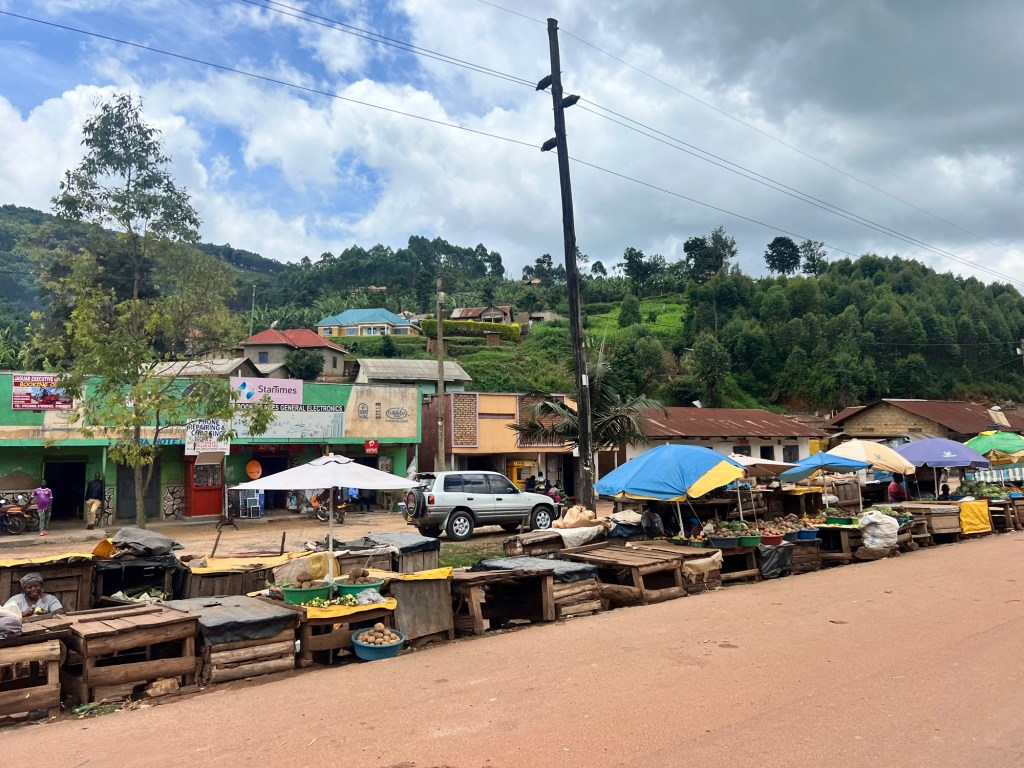
We were approached by a total stranger who wanted to tell us his life story. He saw us sitting on the restaurant balcony and came over. We also noticed (and were told) that kids in particular would call us “mzungu” and then wave or say hi. It is striking being so different in a country that is quite uniform. I never think about what people look like in the US because it is so heterogenous, and I can’t tell you what “typical” lunch might be because the US is so multicultural, but that is not at all the case here. Here, there is one culture, one palate, one look. There’s nothing wrong with it, of course, but it is different from what I’m used to.
After presenting on Friday, we hit the road to Entebbe. 5+ hours. Sigh. It was long, hot, and bumpy, but we made it. And we passed over the equator along the way!
Mbarara city
Mbarara city
Mbarara outskirts
Mbarara
Ugandan town
Grazing cows
Our last day had one and only one objective: to see a shoebill. Shoebills are basically dinosaur birds that missed the memo on extinction. They are 4+ feet tall and they are mean even to their own kind (a mother may have 3 hatchlings, but she will favor the first or strongest and allow the others to starve or let the strongest one kill their siblings). They are also rare and hard to see, so we set off at 7am for the docks where we got into a fishing boat and then eventually into a small canoe to navigate the swamps.
Egret
More egrets
Shoebills are as weird as I expected them to be.
As is the Ugandan way, the sky turned while we were out, so our guides encouraged us to head back.
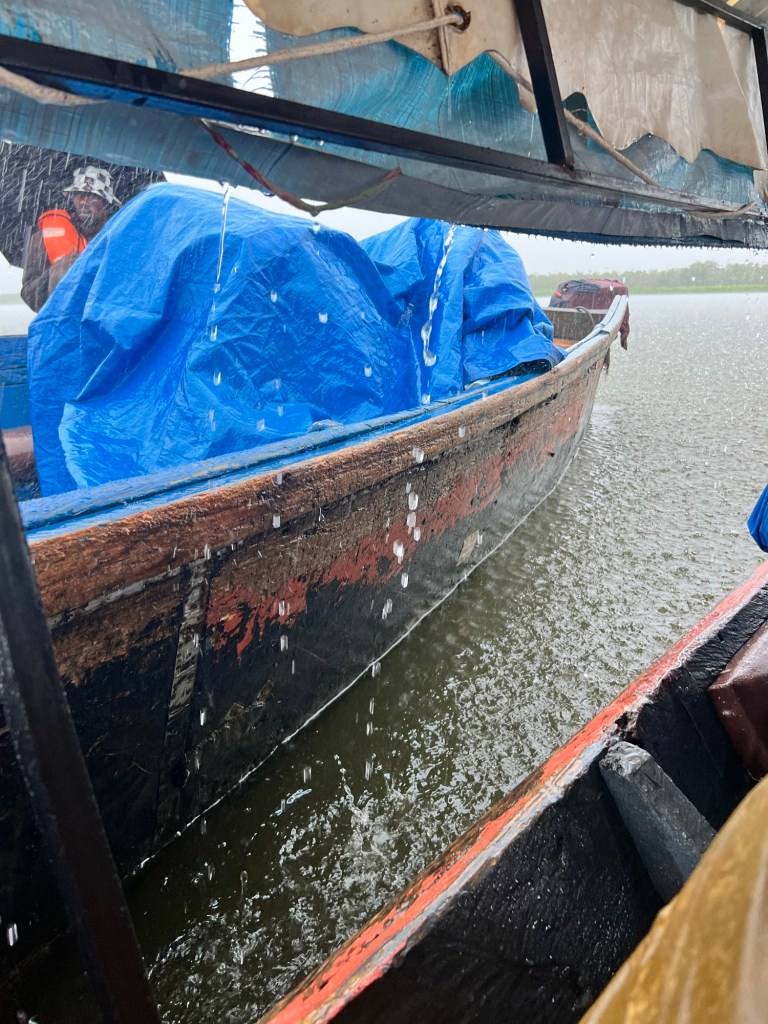
Unfortunately, it wasn’t soon enough. We huddled under tarps while it poured. Eventually, we headed back, and then got stuck in another massive storm, so we are soaked 100% of the way through.
All in all, I had a great trip. Ugandans are friendly, the country is lush, and the wildlife is special.
Big game, that is. Tuesday was Queen Elizabeth National Park day, which means a game drive and a game cruise on the water. This also means another early day (although after 2:30am, 5:30am felt pretty luxurious).
After a breakfast of way too much food (3 courses for every meal is so much!), we climbed into the truck and headed over to the park entrance.
Queen Elizabeth National Park in Western Uganda, has many of the standard large animals, including elephants, African Buffalo, antelopes of all types including Impalas, Bushbuck, and the Ugandan Kob. It is also home to regular lions as well as a family of lions in which the females climb trees. Lions don’t really scare me – I’ve seen them enough to know that they are lazy most of the time – but the idea of a lioness **above** me in the trees is different. The idea doesn’t sit well with me.
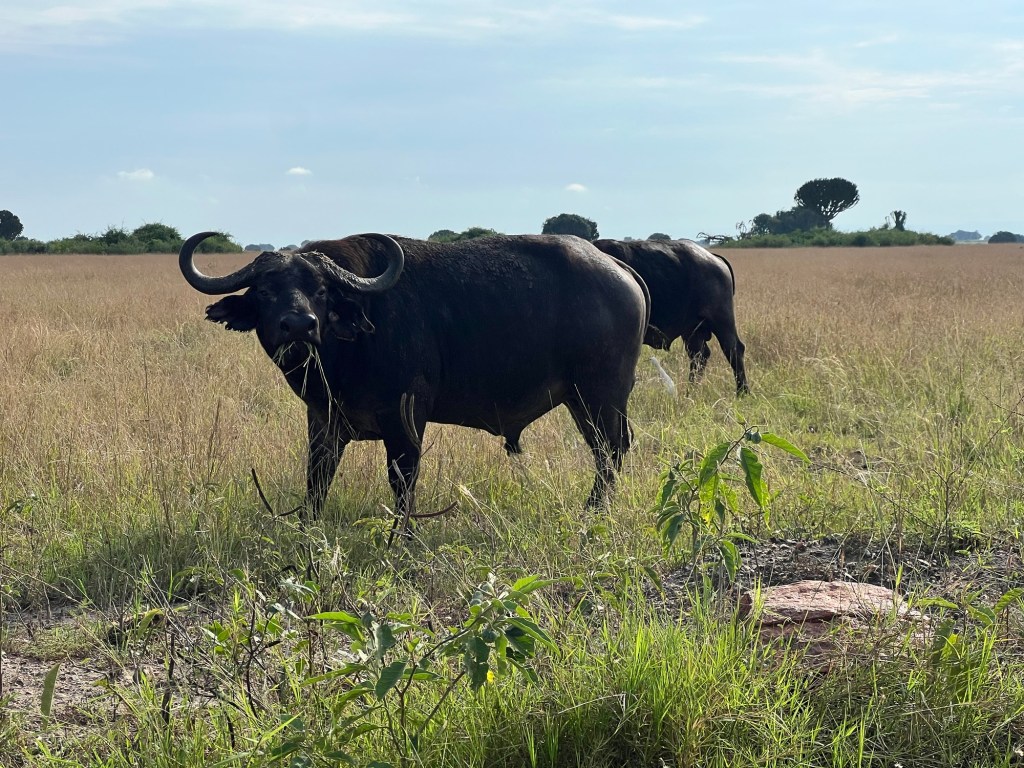
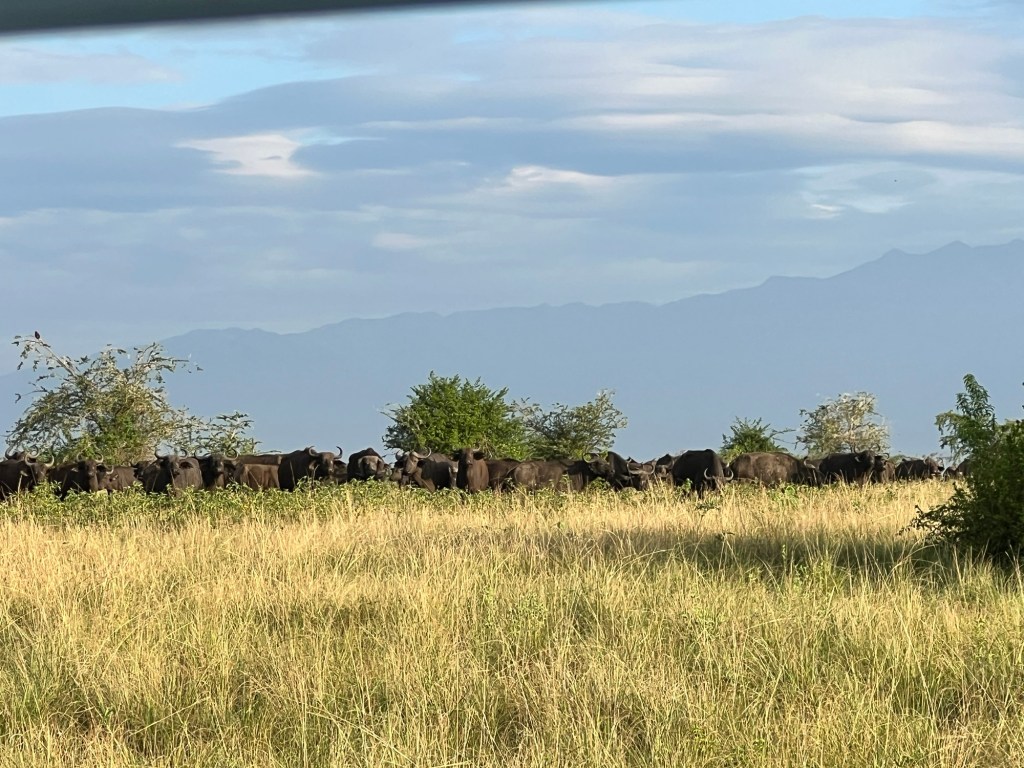
We started off with some African Buffalo (rebranding from Water Buffalo to Cape Buffalo and now to African Buffalo). They never look too bright if you ask me. Like savanna cows with curly horns. They have to be smart enough to survive with predators always lurking, but they just don’t look the part.
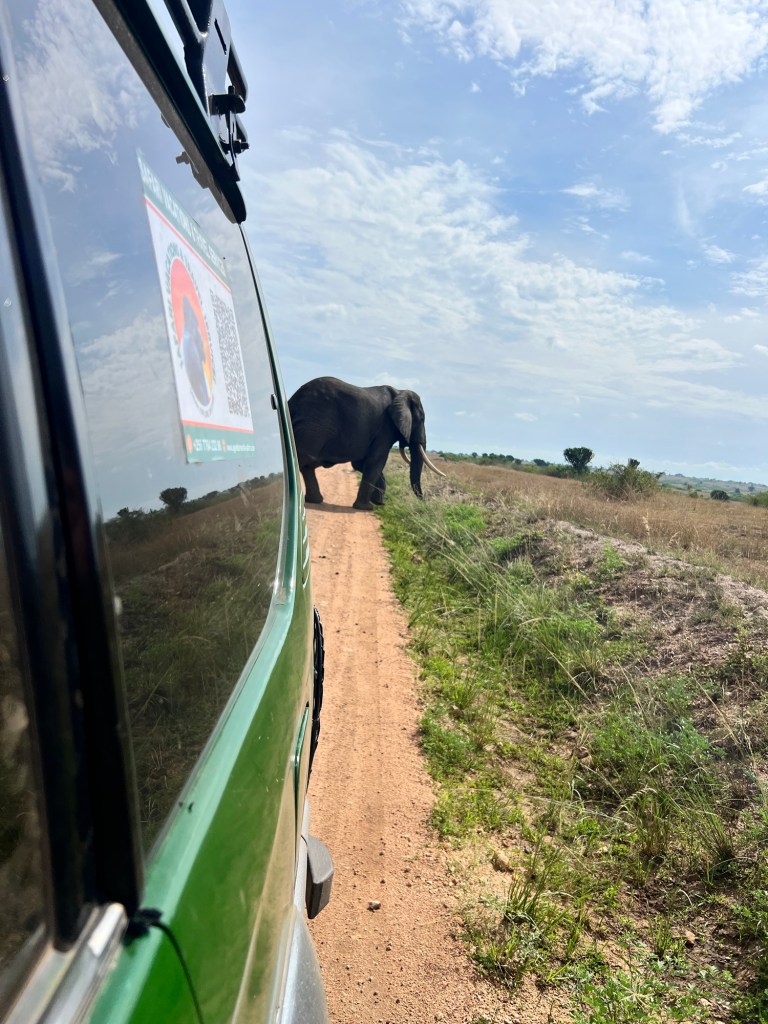
Elephants from a distance are an entirely different experience from seeing them up close. We saw a herd several hundred yards away early on, and then we were treated to a lone, massive male elephant who meandered right behind our truck. This guy was bigger than our Land Rover. Really huge. Pictures do not do him any justice.
Hi there, big guy!
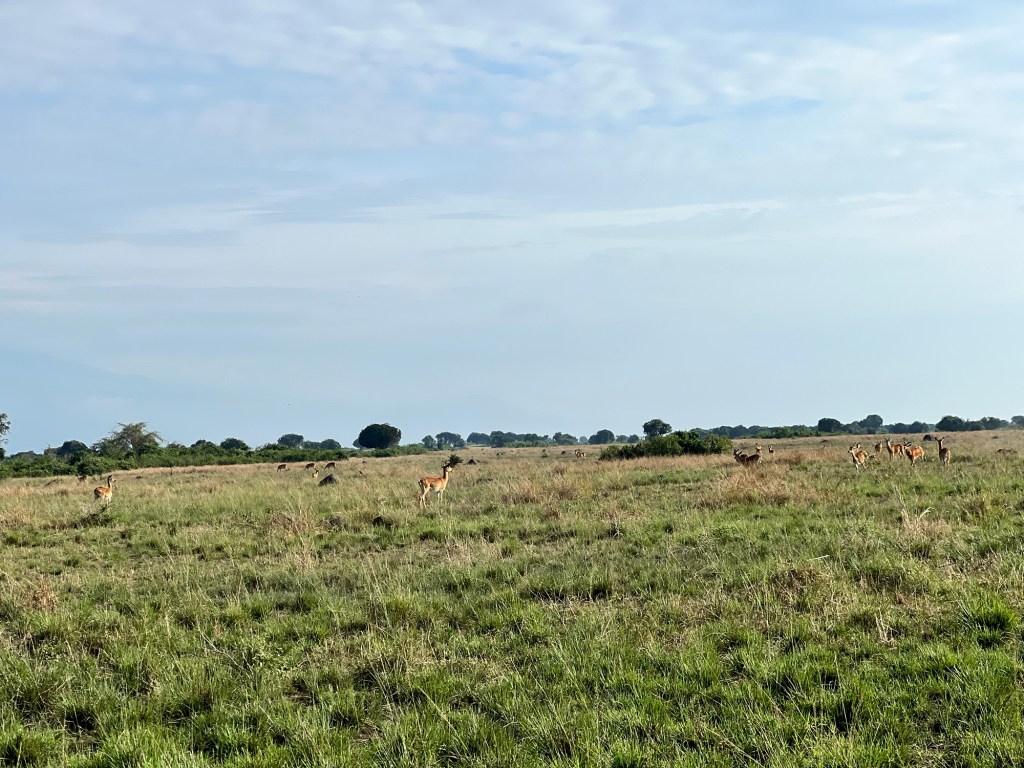
Of course, there were impala everywhere. They are like the squirrels of safaris – kind of cute the first time or two, and then just part of the background.
Impala
We saw regular ground lions and some other antelope-type creatures that were new to me (of course, those photos are still on my big camera) I think I am OK not having seen the tree lions.
After a stop at some local souvenir vendor stalls where Ellie got some trinkets and I bought some of the gorgeous printed fabric that’s ubiquitous in this region, we went over to await our river safari cruise. I don’t usually care much for these, but this was actually better than I expected.
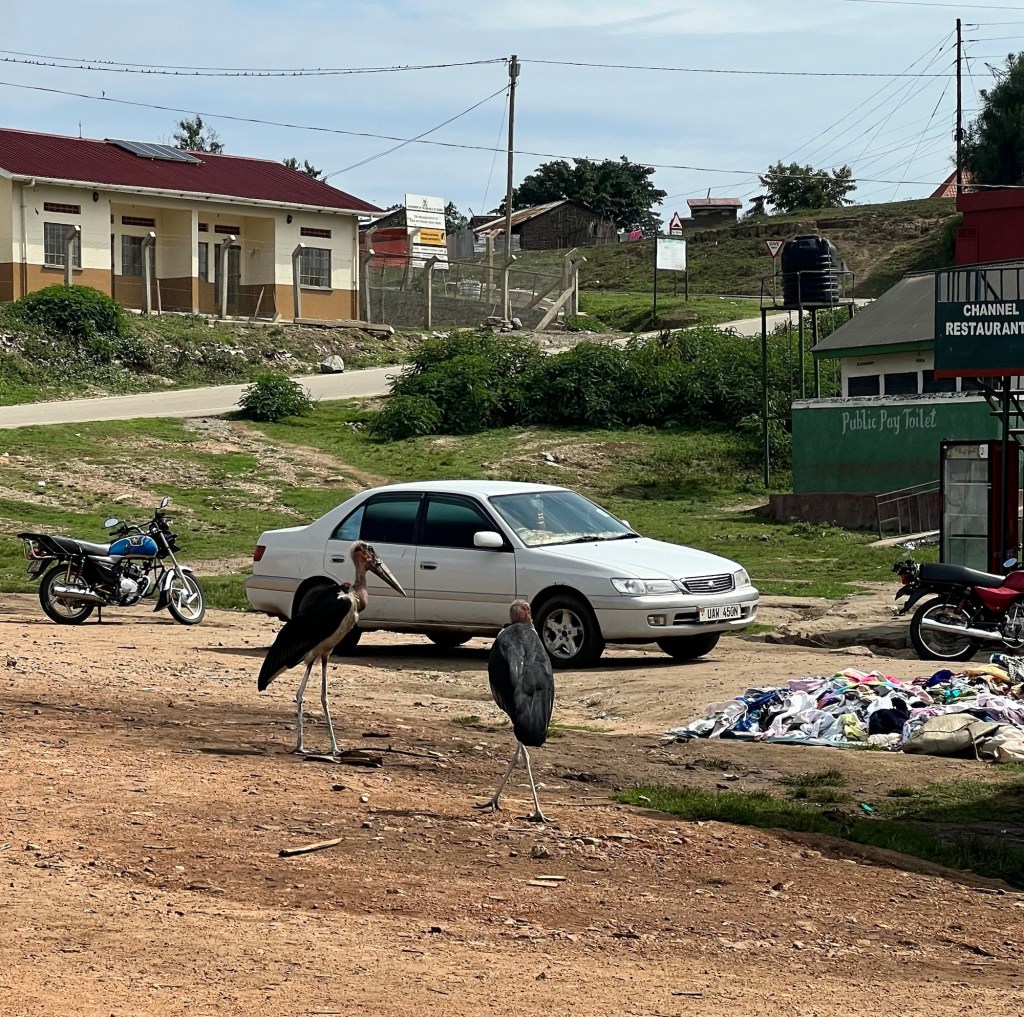
Before we got on the boat, we experienced what locals call “ugly birds” and I see why. These look like the mixture of a stork, an ostrich, and a vulture. They are easily over four feet tall, which is big! They seem to scavenge off garbage, so that’s not flattering. And shockingly, they fly! In Mbarara, we saw them on tops of buildings and nesting in trees. I can’t say these birds have many endearing qualities.
Ugly birds, indeed
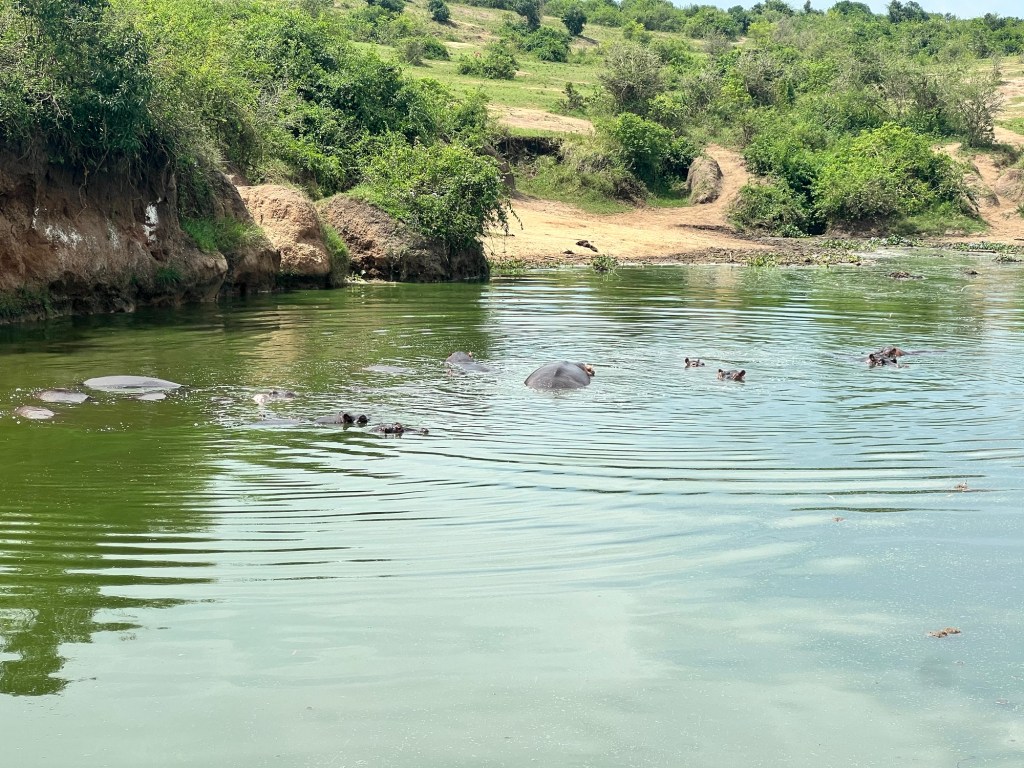
Onto the boat! The lakes we cruised on (Lake George and Lake Edward) have the largest number of hippos in Uganda. Hippos are also the most dangerous animals in Africa (after mosquitoes, if you want to count them as animals). I don’t love that math. 🫣 🫣🫣
Hippos are death monsters under the water, lulling you into a false sense of security with those comically adorable little ears that stick up above the water surface. Don’t be fooled! Like camels, hippos hate you fiercely.
We saw a number of beautiful birds, including Kingfishers, African Fish Eagles, weaver birds, and a stunning bright turquoise bird whose name I never caught. Perhaps most amazing of all was watching the elephants, though. First there was a group of 3 male elephants playing in the water. They ate the papyrus plants growing there, submerged themselves, sprayed themselves, and swam around. It was fun to watch.
Later on, we encountered multiple herds along the water’s edge as they drank their fill (an adult can drink 90-120 liters per day, which is roughly 20-30 gallons). Adults would trumpet or face to confront the boat if it go too close to the babies. Again, photos are on my camera, so words will have to suffice here.
It was a great day, and it was wonderful to see a different region of the world. If I had to pick, I would still put Kenya as my favorite safari experience (Samburu was absolutely amazing), but Uganda has plenty going for it!
3am pick-up time. I signed up for that. Voluntarily.
Why, you might wonder?
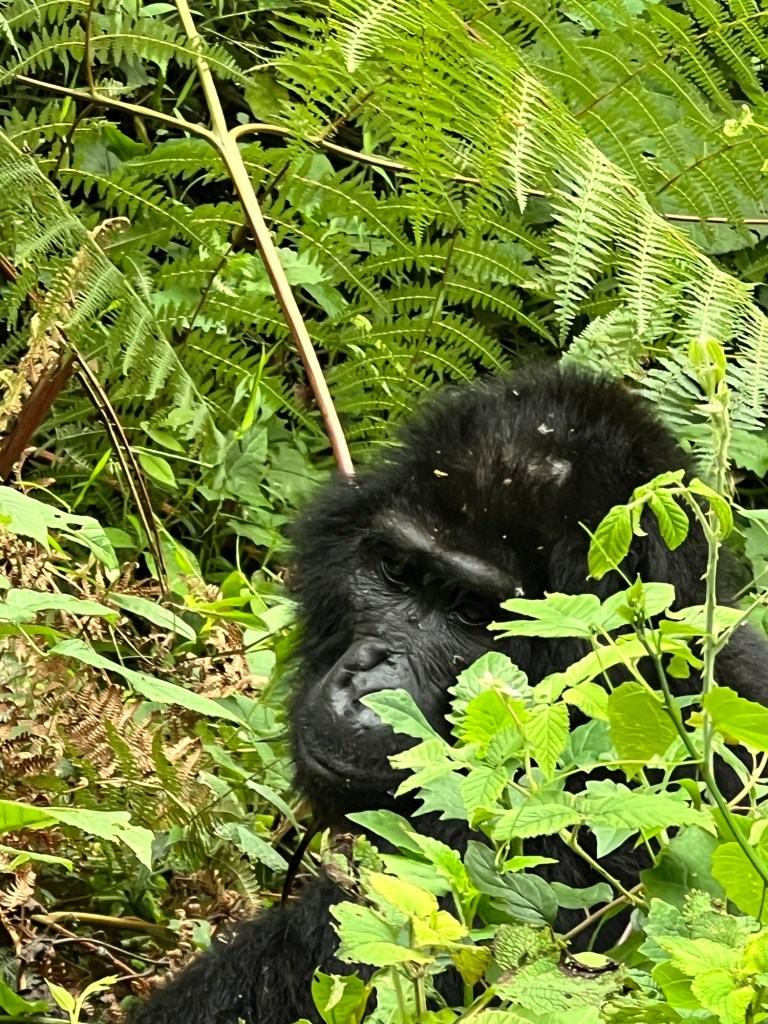
Gorillas. Specifically, Mountain Gorillas, of which there are barely one thousand of remaining on this planet, and which we get to go and see.
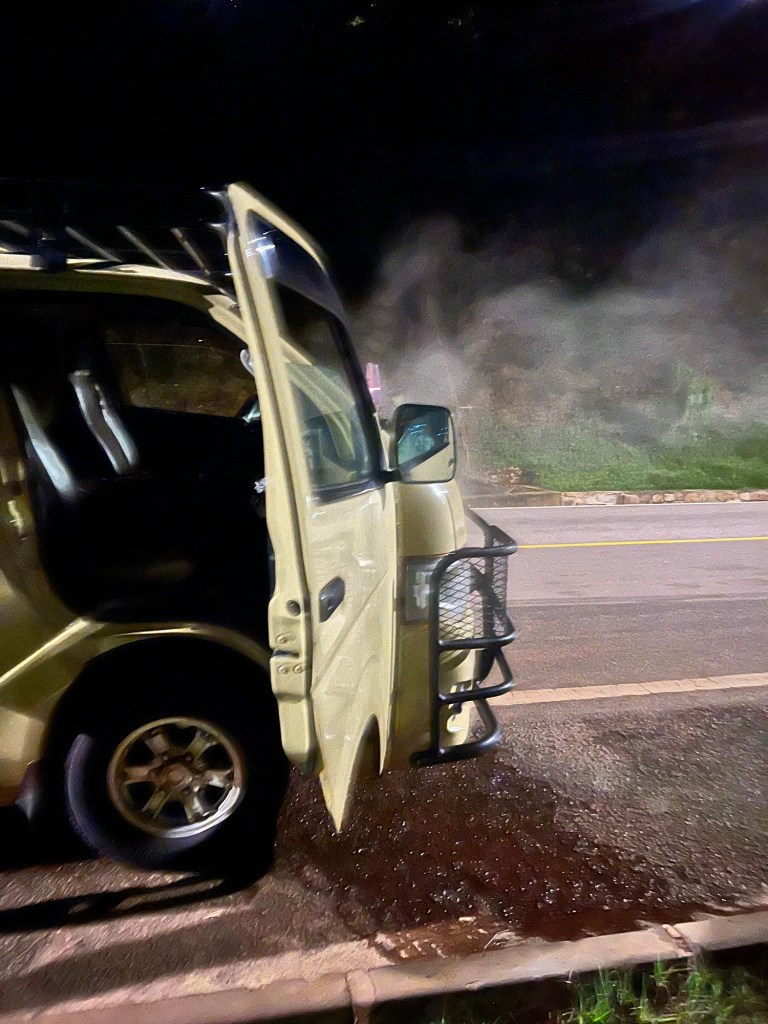
So, we painfully got ourselves up and met our guide and driver for the next 2 days. About halfway across Rwanda, the car seems to be having some trouble. Our driver is on the phone (he seems to have a network of people to call at 3:45am!!). And then…
…the radiator blows and we are not moving. Thankfully, one of the calls the driver made was to somebody who was able to get us after only a 20ish minute wait and drive us to the border. Another call our driver made was to the office, where another car was waiting for us at the border station.
I was transporting supplies with me to take to Mbarara. This is common among our colleagues, and I knew what was in the bag, so I wasn’t worried. I knew I might have to pay customs fees, but this transaction felt weird. Ultimately, our driver spoke to the customs agent discretely and slipped him some cash so we could proceed. I was grateful because my experience with bribes is not terribly robust and I wasn’t really sure how that worked. Do you ask the price? Do you suggest an amount for him to forget about the bag? How much is fair? How much is insulting? Well, I don’t need to know those things because it’s all set. On we go!
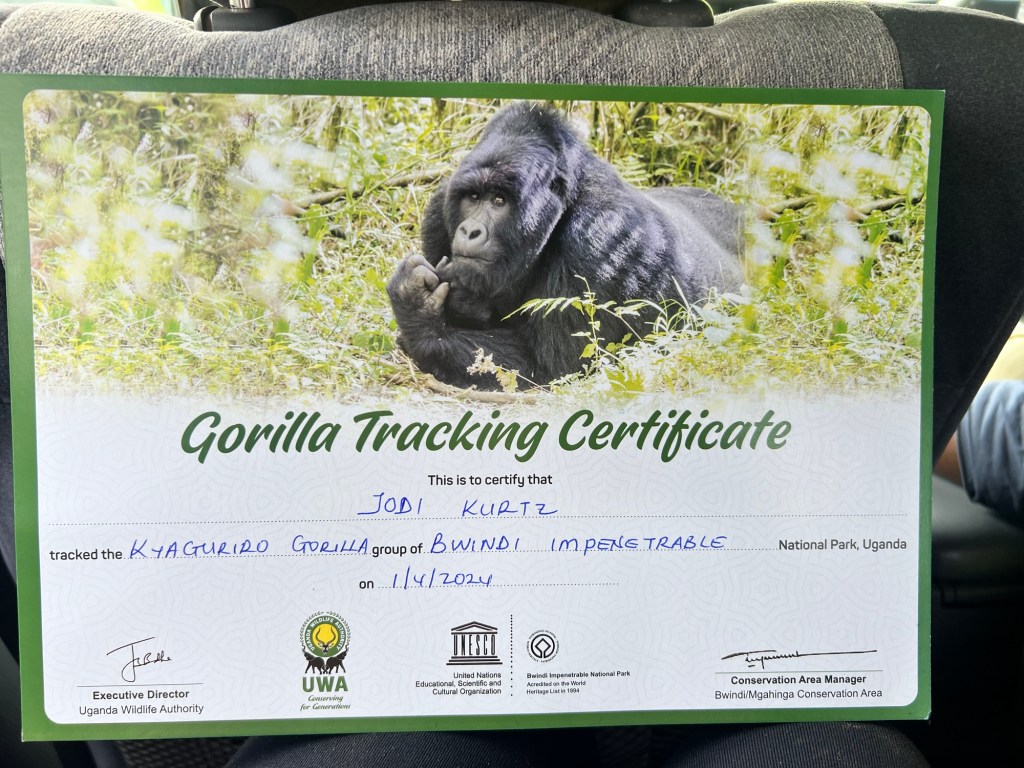
One of the other calls our guide made was to arrange for us to potentially be assigned one of the gorilla families that was more easily accessible since we were going to be late and we had a long drive in the afternoon. We arrived at Bwindi Impenetrable Forest and met our trackers and rangers. We were very pleased to not have to join other groups on their hikes!
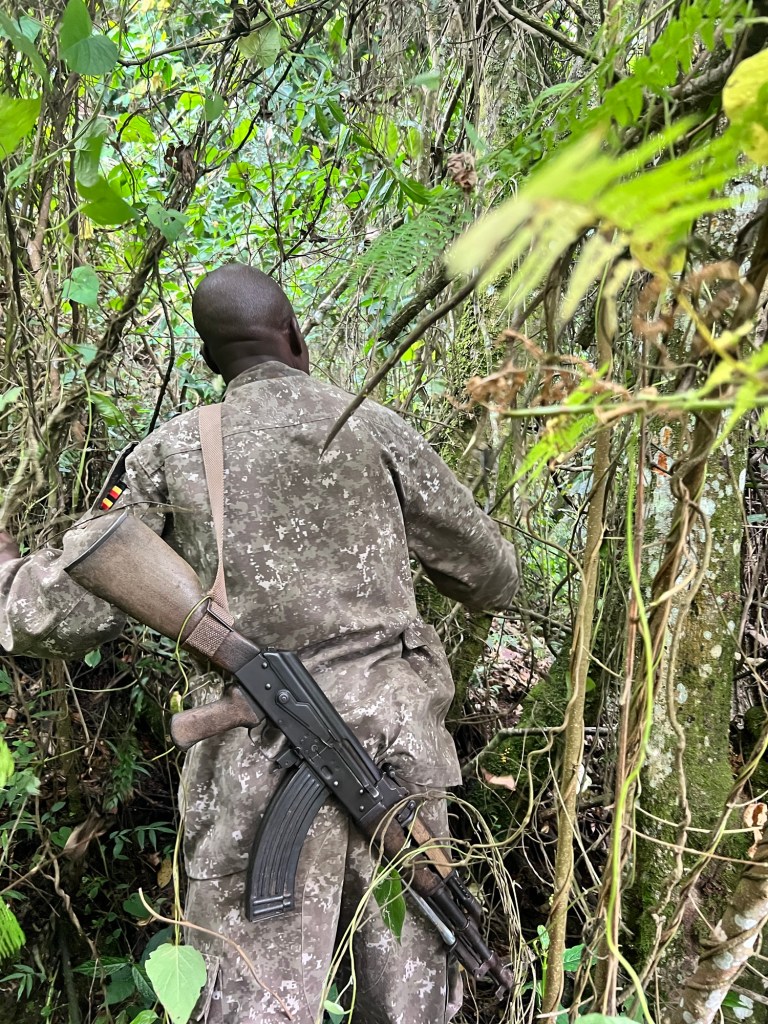
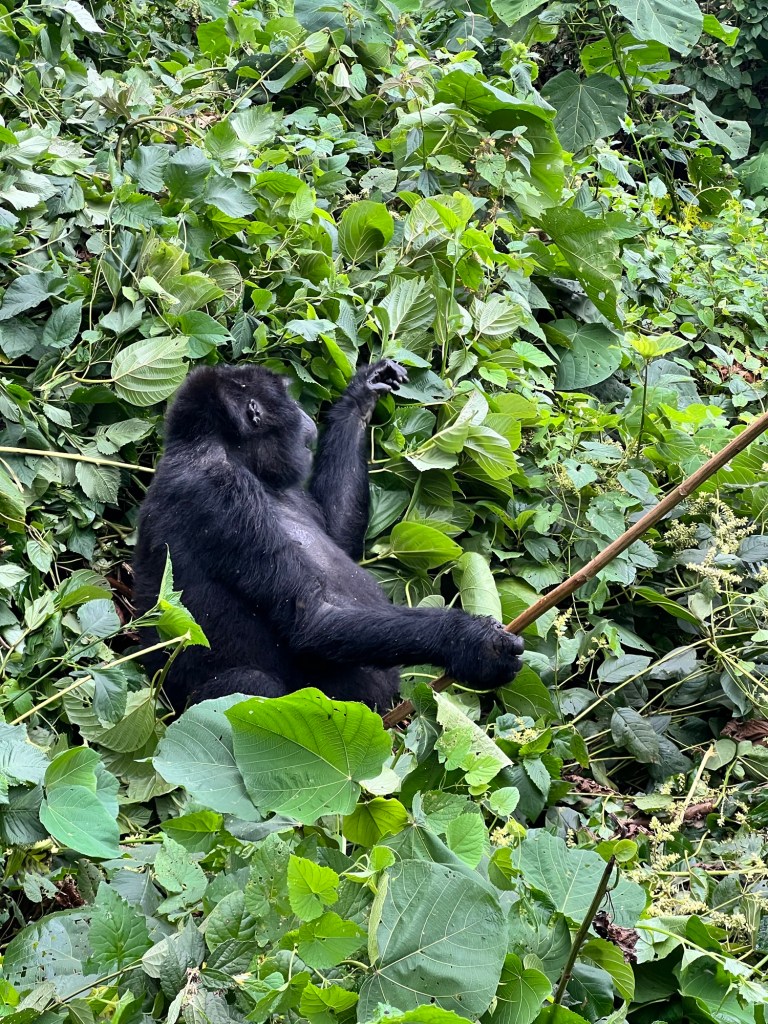
This hike was NO JOKE! Other than the single step from the road, you are never walking on solid ground. It’s a crazy jumble of vines, saplings, and other vegetation that the trackers had to machete through. It was hot, humid, very difficult physically, yet completely worth it when you catch your first glimpse of a gorilla in the wild.
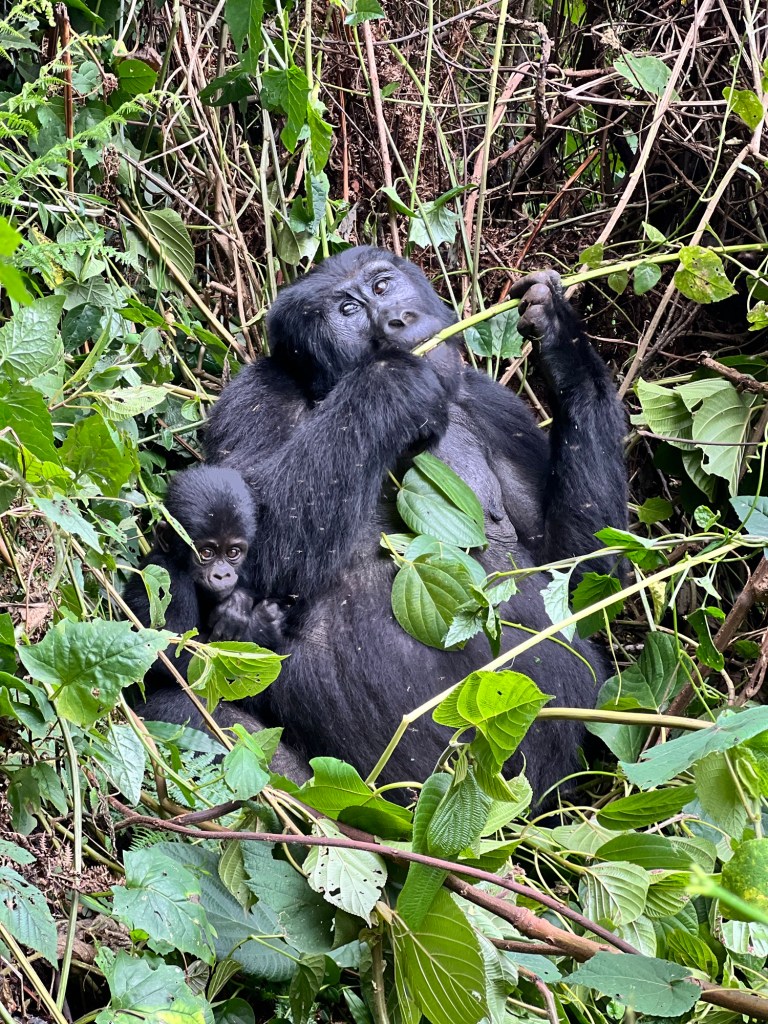
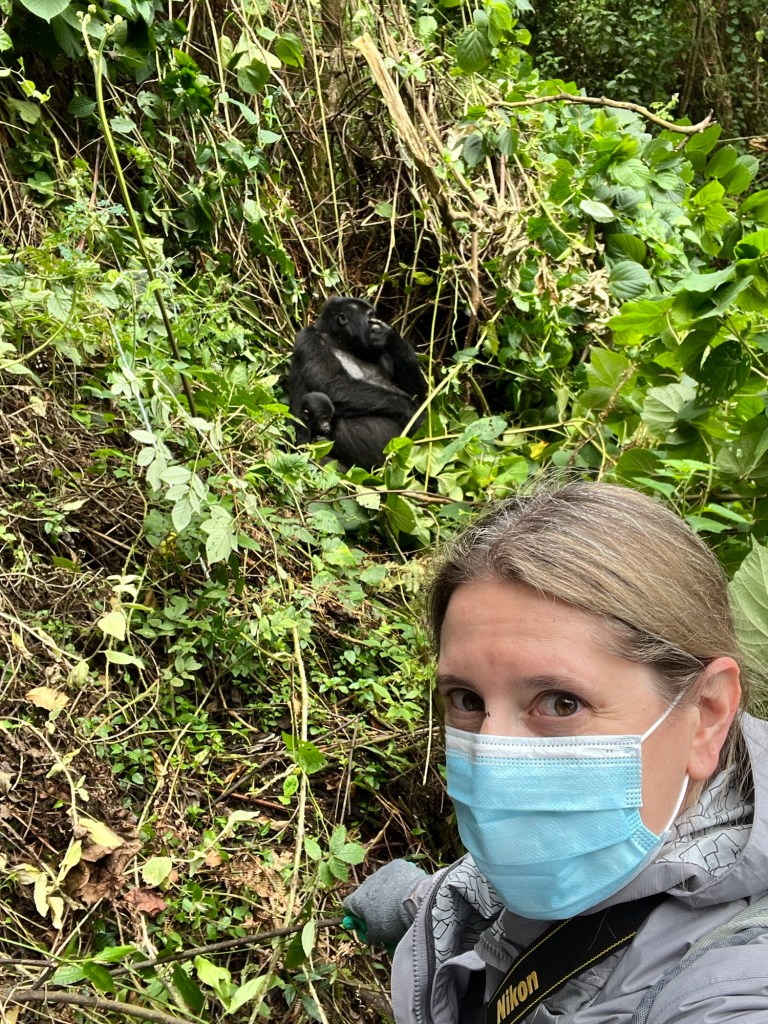
Momma and her 8 month-old babyWe are SO CLOSE!!
There was also a massive silverback in this group. We heard him, and the rangers made grunting sounds back at him. Then they told us to have our cameras ready. (Ready for what? I wondered). Well, I don’t know what you do when 450ish pounds of muscle and fur comes flying through the air in front of you, but I help and flail my arms around. I do not have my camera steady, nor do I have sufficient brainpower to remember how to use it. Silverbacks are big, strong, and scary. They do their job well, and I was happy enough to let him be.
We spent one hour with the gorillas (they don’t sit still, so one hour with them = one hour navigating the challenging terrain). I loved every second, but my body was physically exhausted and so we did not protest when we had to leave.
I understand why the cost of gorilla tracking is so high – these magnificent creatures need serious protection and that is costly – but it is sad that most people will never get to look into the eyes of a wild gorilla. It’s magical.
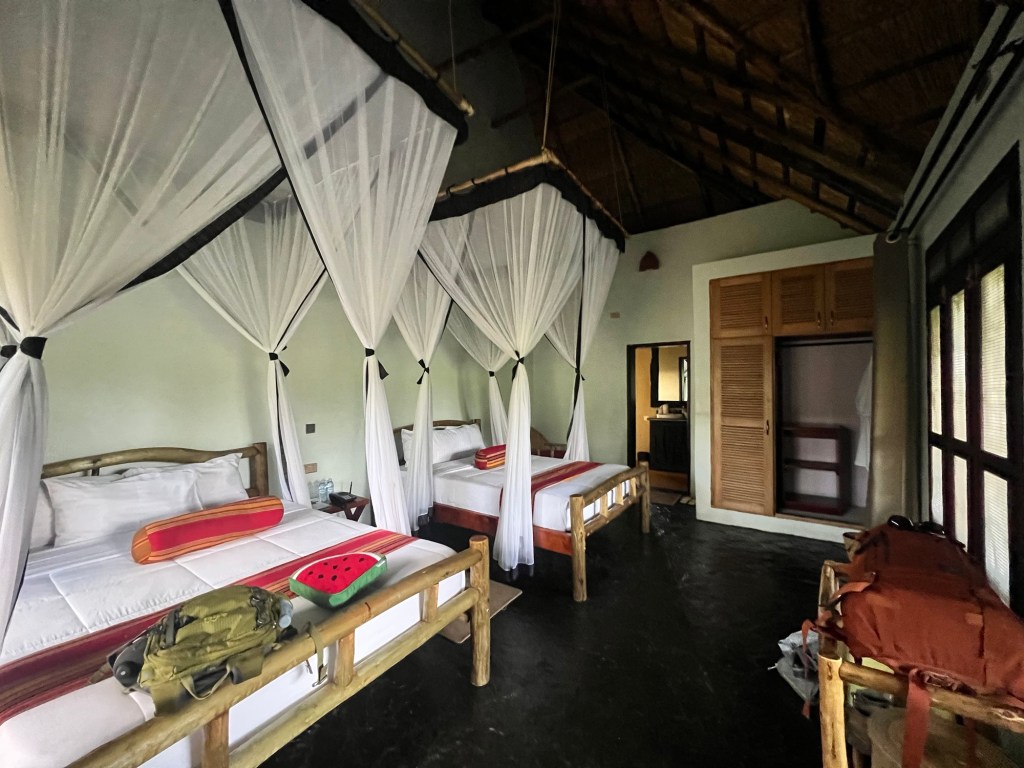
After a lengthy drive, we finally arrived at our lodge for the night in Queen Elizabeth National Park. Ellie’s never been on safari, so tomorrow is a big day for her!
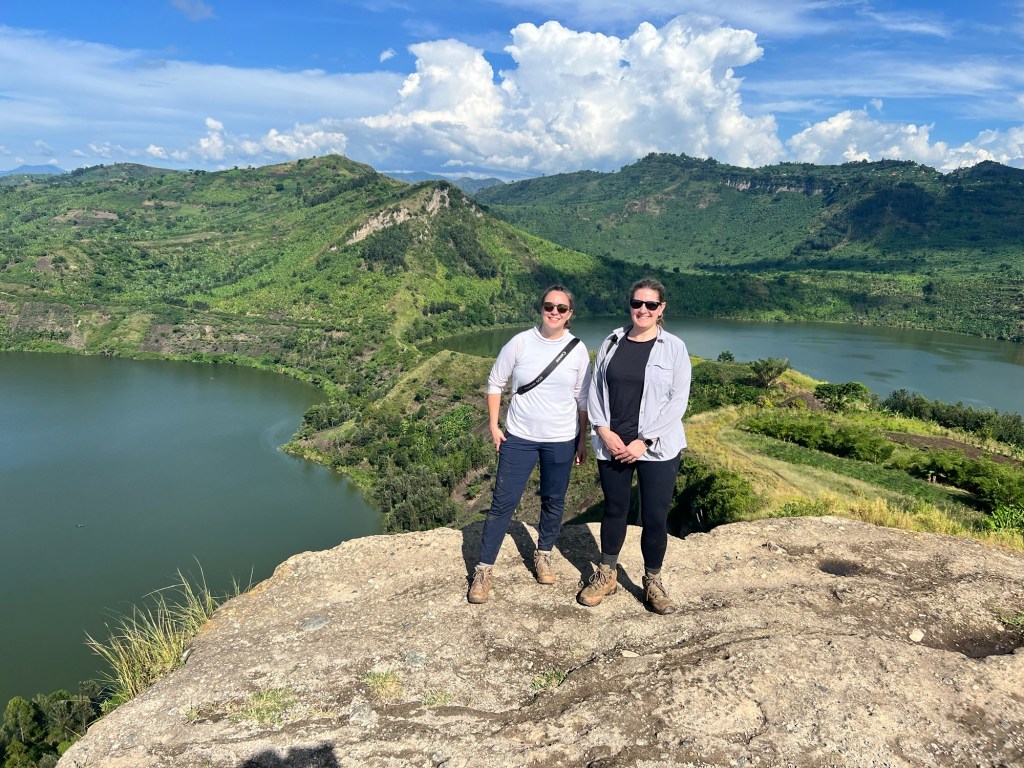
Western UgandaTwin crater lakesVery nice lodge for the evening
Sunday was our lone Kigali day. Despite the depressing tone, we wanted to go to the Genocide Memorial. I had memories of the genocide, but truly, no real appreciation for the scale and speed of the Rwandan experience. One million civilians (or 500,000-800,000 according to some scholars, although when speaking of lives lost in the hundreds of thousands, any number greater than 0 is too many) were slaughtered in 100 days in 1994. How humans can turn on each other like that is simply incomprehensible, but having just spent time in Budapest learning about the annihilation of the Jewish population of Hungary, it clearly happens again and again.
Moments after we set out, the sky ripped open and it poured, so we hunted for someplace serving coffee (tea is not the same, no matter how much people try to convince me otherwise). We read the guidebook, drank coffee, and admired these cool pink birds roosting up in the trees.
The Genocide Memorial is as somber as you might expect. Outside, it is beautifully landscaped and also simple in its displays. Large concrete slabs mark the mass burial site of a quarter million people who died during the genocide, and a wall of names is being constructed (most victims have not been identified, so it is a work in progress).
We thought it might be best to lighten the mood a bit for the afternoon, so we set out on foot to find a coffee roaster or local coffee shop. Being Easter Sunday, some places were closed, but we did manage to find some good coffee before heading out to dinner at a cool restaurant founded by a woman who uses the restaurant to train Rwandans in food service and hospitality jobs. food was excellent, as was the view!
We had an early bedtime because the next day was the highlight of the trip – gorilla tracking!
April vacation week is coming up. I’m not one to miss a vacation, so the $221 deal to Colombia seemed like the perfect fit. Leave Thursday, return the following Saturday. Kiddo misses 2 days of school because she’s a senior (and her parents are cool like that).
Then the plan starts to evolve and grow a mind of its own. Avianca decided not to fly from Boston to Bogotá on Thursdays anymore, so we had to rebook to Wednesday afternoon. A long contemplated work trip to Uganda suddenly falls into place for me and a coworker/friend. There’s a solar eclipse happening. The result is a schedule that is insane:
March 29: Ellie and I fly to Amsterdam
March 30: fly to Kigali, Rwanda
March 31: Kigali
April 1: land crossing to Bwindi National Forest in Uganda for gorilla tracking
April 2: Queen Elizabeth National Park safari drive and river safari
April 3: Mbarara, working
April 4: Mbarara, working
April 5: Mbarara, transfer to Entebbe
April 6: Shoebill swamp tour and explore Kampala; midnight flight to Amsterdam
April 7: Ellie and I part ways; I sleep a few hours in the airport hotel, then fly home
April 8: drive to NH for the eclipse and drive back home
April 9: normal workday followed by a Bruins game
April 10: evening flight to Bogotá
April 11: Bogotá
April 12: Santa Marta and Tayrona National Park yacht cruise
April 13: Santa Marta and Cartagena
April 14: boat to Rosario Islands and stay the night
April 15: return to Cartagena
April 16: fly to Pereira, drive to Salento and tour a coffee finca
April 17: valle corcora and drive to Manizales
April 18: hot springs
April 19: fly back to Bogotá
April 20: fly home
Tomorrow is day 1 of this epic journey. Tonight we barely managed to feed ourselves (very good Indian and middle eastern food) and now it’s bedtime. Tomorrow we start the day with the Genocide Memorial/Museum – a haunting experience, but also really important to learn about and it is thoughtfully done from what I’ve heard.
After a late arrival, we settled into our hotel. While perfectly adequate, it was a step down from our prior accommodations. In Bratislava, we basically stayed in a tiny castle. In Budapest, it was a B&B, but clearly a local-owned one. In Dublin, we stayed in a chain hotel. Anyway, we weren’t there for the hotel room, so it was fine enough.
We started the day with Dublin Castle. I don’t think we were here when we came to Dublin nearly 18 years ago. In fact, I only recall seeing Trinity College’s library and the Book of Kells when we came previously. Sadly, this is another one of those places where you can only see some parts on a guided tour, so we stuck with the palace parts which we could self-tour. Dublin Castle is a working palace, and while the president doesn’t live here, official events are still held here when other global dignitaries visit.
Record Tower, under construction
Castle Church, only accessible via guided tour
Palace ballroom; Anna-Sophia was tickled to learn that they use the same microphone input jacks as she does in school
St. Patrick’s Cathedral was next. In Dublin, we found that most sights included audio guides (either hand-held or as a phone app). These were not things we experienced in Budapest or Bratislava. While I do like to learn about what I’m looking at, I am not convinced that the audio guide is my favorite. Sometimes the written visual placard is less intrusive.
St. Patrick’s Cathedral
St. Patrick’s Cathedral had one really interesting trait that I had never thought would be possible – it identifies as both Anglican and Catholic. How that can be, I simply don’t quite understand. At least historically, those two religions have fought and been the cause of so many lives lost, that to think of them both sharing a cathedral is shocking. I suppose modern Ireland is in a different place, but their religious-fueled battles are not so ancient (when we were in Belfast 18 years ago, there was a car bombing).
We stopped for a fancy lunch (we were hungry, so we picked the first thing we saw, otherwise, we all get cranky and then nobody can make a decision). This was the self-proclaimed 6th best steakhouse in the world. Luke and Anna-Sophia certainly seemed to enjoy their meat. I was blown away by the fact that they had a vegan Wellington on the menu. Europe is light years ahead of the US when it comes to vegetarian food. Every restaurant has options (plural), and they are clearly marked on the menu. In the US, I typically have one option, and it is either the veggie burger (typically, mushy and salty), or the grain/rice/stir-fry bowl (typically uninspired). Going out to eat in the US is not always that exciting for a vegetarian, but in Europe, it feels like they really try.
After lunch, we went to the Christ Church Cathedral.
Christ Church Cathedral
This also had an audio guide, but I liked it better because it gave a short (<1 minute) explanation of an object/sight, and then there were options to hear more about different aspects of it. This experience was more of a choose-your-own-adventure type.
“Friar Foxes” on the floor tiles
As with our experience in St. Matthias Church in Budapest, this church gave visitors a variety of angles from which to explore. Here, the church has a large crypt with artifacts (including a Magna Carta from the 13th century and a mummified cat), as well as a stunning interior.
We spent the afternoon exploring Dublin’s quaint little streets and shops, then went back to the hotel to rest a bit. Luke and I had a Guinness at the hotel bar, and we marveled at how they poured it. There are these funny-shaped cans that go into what almost looks like a beer pat mixed with a press. The press pierces the can, and the beer slowly pours out into the glass. When it is about 80% full, it pauses to allow the beer to settle (as Guinness is designed to be poured), and then the bartender completes the pour after the beer has had it’s 2-minute rest. It was a pretty cool way to have a properly-poured Guinness without a true nitrogen tap system.
On Sunday morning, we went over to the Guinness Storehouse. Anna-Sophia was not initially excited about touring a beer factory, but she did agree afterwards that the museum was really well done and was interesting both in content and from a multi-media presentation perspective. Of course, we had to have our pints in the Gravity Bar overlooking the city and peruse the shop for Guinness merchandise before heading home.
All in all, this was a great trip. We don’t travel in Europe too often lately. As much as the countries are all different, it can feel a bit repetitive after being to man of Europe’s major cities, but Bratislava and Budapest offered really different perspectives than Rome or Paris. In hindsight, I slightly wish I had done them in a different order. I’d do Dublin first, because it is the most like other major European cities. Then I’d do Bratislava, which was adorable and easy, and then I’d end in Budapest. Or Budapest and then Bratislava, but with Dublin still first. Still, it was a really nice mix of cities, with a little bit of everything.
I didn’t realize that Ireland isn’t part of the Schengen area. Immigration lines were short so that wasn’t a big deal, but I am certainly cutting things close with my passport. One (giant, half-page sized) stamp to enter Ireland, one normal stamp to enter the Schengen in Bratislava, one normal stamp to leave the Schengen in Budapest, and then I’ll get at least one more giant entry when we land in Dublin again. That will leave me with one blank page, at most, and more likely only half a page. If an Ireland stamps on the way out, I’m not sure how it will all fit! I definitely need to get a new passport the minute I get home if I intend to make it to Uganda in a few weeks! And, of course, the US system for getting a new passport is so slow and cumbersome that I’ll be nervous until my new passport arrives.
Anyway, Thursday was a totally packed day in Budapest. We started with St. Stephen’s Cathedral which was less than a block down from our hotel. It was a really large cathedral, with all the ornate trimmings you’d expect. It also had some trimmings I wasn’t expecting, like a relic (the mummified right hand) of King St Stephen. While a perfectly lovely cathedral, there is certainly a bit of repetitiveness once you’ve seen several dozen cathedrals around the world.
St. Stephen Cathedral
The cathedral has an impressive organ; they put on organ concerts which we thought about going to, but 55euro per person seemed like a steep price.
There’s a mummified hand in there!
After crossing the river, we peeked into the Church of St. Anne. Very baroque and not at all like St. Stephen’s Cathedral.
Then we started going uphill. So much uphill. Each time we turned a corner and saw a flight of stairs, we all had flashbacks to Cusco and the torture of those stairs. Thankfully, these are more contemporary, with relatively even steps and breaks in between…plus, they are not at 11,000 feet of elevation, so we could actually breathe the whole time we were climbing. At the top, we we rewarded with a somewhat confusing array of architectural marvels in front of us.
Fisherman’s Bastion and St. Matthias Church. The Fisherman’s Bastion is a protective wall built along the hillside – it is elaborate, and provides visitors (and defensive forces, historically) with multiple viewing angles to stand and look out over the city.
Fisherman’s Bastion
Wonderful views of the city
St. Matthias Church was stunning. From the exterior, with its elaborately tiled multi-colored roof, to the interior, with the colorful floors and columns. Standing in this church, you could feel what it would’ve been like to be here hundreds of years ago as royalty and nobles walked through. It was initially founded in 1015 – that is an incomprehensibly long time ago!
Colorful roof tiles of St. Matthias Church
We spent a fair amount of time in that church. Visitors were allowed to go upstairs, so we could see the church from different angles. Seeing the church from above gave a very different perspective, making it feel smaller once the tremendous height of the vaulted ceilings was removed from the equation. At the same time, it also brought you closer to the ornate decoration, which made it feel grand but on a different scale. This was a surprisingly wonderful stop (Europe has a LOT of old churches, so it is easy to get jaded…as we did with St. Stephen Cathedral).
Thursday was much colder than the days before (we were also up in the Buda Hills, which exposed us to the wind). We headed over to Buda Castle with plans of walking around the massive compound, but we were cold and the whole site is under construction, so we did an abbreviated tour. Buda Castle is pretty, but again, it’s a castle in Europe. If you’ve been to one, you have a pretty solid sense of what you’ll see here.
Buda Castle
Buda Castle gate
One area that was accessible to tourists and that was indoors (doble win!) was St. Stephen’s Hall – some of the rooms of the Royal Palace. We meandered our way through, admiring the opulent decor.
The castle also includes a museum and several other areas of the castle. The museum was pretty good – not too big – and I learned a lot about a region of the world that I truthfully knew little about pre-WWII. Huns, Ottomans, various European powers…it seems like everybody was in Hungary at some point!
In the castle museum, we were able to learn about how water was collected and transported, walk through the cellars, and explore the King’s Chapel. It was all quite nice, and warmly indoors. 🙂
Cellar, with restored/preserved Gothic arch ceiling
We stopped for a light lunch in the castle cafe and planned out the afternoon. I had planned to tour Parliament on Friday, but we thought maybe we do it Thursday given the fold (Parliament is indoors). Alas, that is when I learned that we needed advance tickets to see Parliament and that it was sold out for both Thursday and Friday (except in Spanish, but my Spanish isn’t that good!). They only allow visitors with guided tours, and since we typically don’t appreciate a guided tour, we agreed we were not devastated to miss it.
Instead, we agreed to head right to Rudas Baths. A long soak in a hot bath would do wonders for our chilled bodies. Budapest has a funicular that will take you up and down the hill (the one with he hundreds of stairs that we climbed). I thought maybe we’d take it down, but it was not cheap and it was quite small, so we just walked down the hill and stopped to get a photo of it. I love a good funicular, as everybody knows, but I just couldn’t spend $15/person for such a short distance.
Chain Bridge with Parliament in the background
Rudas Baths are interesting. One half is very contemporary, with a large swimming pool and 4 hot pools at various temperatures. The other half is a very old (1571/2) and dates back to when Budapest was under Ottoman rule. This older half feels very much like a Turkish bath, with the octagonal pool and the domed roof with multi-colored glass tiles.
Rudas Baths are not co-ed most of the week (they only require bathing suits on co-ed days, too). One of the more interesting aspects of Hungarian baths is how they approach the changing rooms. In the US, there would be a women’s and a men’s changing room, most likely on opposite sides of the facility. Here, there is a single large locker room used by all visitors, and then there are changing cabins throughout where you go to change. Cabins are single person so you have privacy, but the mixed locker room aspect of it is unusual to an American. It works, and it saves on space, but it just isn’t a model that we’ve adopted.
We went back to the hotel to hang up our wet swimsuits to dry and then went out for dinner. On the way back, we stopped for a peek at the New York Cafe – one of the most opulent cafes in the city. None of us were interested in waiting in line for an hour for dessert, so we walked in, took photos, looked around, then went back to the hotel to pack since we had a Friday flight.
New York Cafe
Friday we meandered the city, shopping, stopping in cafes, and then eventually heading to the airport to fly to Dublin. Both Bratislava and Budapest were far better than I had expected them to be. Bratislava was relaxed, bright and open, and super clean. Budapest had a lot more historical charm than I expected, plus the modern urban vibe of a major metropolitan city. Both had good food, very friendly people, felt safe, and offered us a chance to learn a lot about the history and culture of a region we hadn’t much explored.





 Vacation Days