A Day in Dublin

After a late arrival, we settled into our hotel. While perfectly adequate, it was a step down from our prior accommodations. In Bratislava, we basically stayed in a tiny castle. In Budapest, it was a B&B, but clearly a local-owned one. In Dublin, we stayed in a chain hotel. Anyway, we weren’t there for the hotel room, so it was fine enough.

We started the day with Dublin Castle. I don’t think we were here when we came to Dublin nearly 18 years ago. In fact, I only recall seeing Trinity College’s library and the Book of Kells when we came previously. Sadly, this is another one of those places where you can only see some parts on a guided tour, so we stuck with the palace parts which we could self-tour. Dublin Castle is a working palace, and while the president doesn’t live here, official events are still held here when other global dignitaries visit.

Record Tower, under construction
Castle Church, only accessible via guided tour
Palace ballroom; Anna-Sophia was tickled to learn that they use the same microphone input jacks as she does in school

St. Patrick’s Cathedral was next. In Dublin, we found that most sights included audio guides (either hand-held or as a phone app). These were not things we experienced in Budapest or Bratislava. While I do like to learn about what I’m looking at, I am not convinced that the audio guide is my favorite. Sometimes the written visual placard is less intrusive.

St. Patrick’s Cathedral

St. Patrick’s Cathedral had one really interesting trait that I had never thought would be possible – it identifies as both Anglican and Catholic. How that can be, I simply don’t quite understand. At least historically, those two religions have fought and been the cause of so many lives lost, that to think of them both sharing a cathedral is shocking. I suppose modern Ireland is in a different place, but their religious-fueled battles are not so ancient (when we were in Belfast 18 years ago, there was a car bombing).

We stopped for a fancy lunch (we were hungry, so we picked the first thing we saw, otherwise, we all get cranky and then nobody can make a decision). This was the self-proclaimed 6th best steakhouse in the world. Luke and Anna-Sophia certainly seemed to enjoy their meat. I was blown away by the fact that they had a vegan Wellington on the menu. Europe is light years ahead of the US when it comes to vegetarian food. Every restaurant has options (plural), and they are clearly marked on the menu. In the US, I typically have one option, and it is either the veggie burger (typically, mushy and salty), or the grain/rice/stir-fry bowl (typically uninspired). Going out to eat in the US is not always that exciting for a vegetarian, but in Europe, it feels like they really try.

After lunch, we went to the Christ Church Cathedral.

Christ Church Cathedral

This also had an audio guide, but I liked it better because it gave a short (<1 minute) explanation of an object/sight, and then there were options to hear more about different aspects of it. This experience was more of a choose-your-own-adventure type.

“Friar Foxes” on the floor tiles

As with our experience in St. Matthias Church in Budapest, this church gave visitors a variety of angles from which to explore. Here, the church has a large crypt with artifacts (including a Magna Carta from the 13th century and a mummified cat), as well as a stunning interior.

We spent the afternoon exploring Dublin’s quaint little streets and shops, then went back to the hotel to rest a bit. Luke and I had a Guinness at the hotel bar, and we marveled at how they poured it. There are these funny-shaped cans that go into what almost looks like a beer pat mixed with a press. The press pierces the can, and the beer slowly pours out into the glass. When it is about 80% full, it pauses to allow the beer to settle (as Guinness is designed to be poured), and then the bartender completes the pour after the beer has had it’s 2-minute rest. It was a pretty cool way to have a properly-poured Guinness without a true nitrogen tap system.

On Sunday morning, we went over to the Guinness Storehouse. Anna-Sophia was not initially excited about touring a beer factory, but she did agree afterwards that the museum was really well done and was interesting both in content and from a multi-media presentation perspective. Of course, we had to have our pints in the Gravity Bar overlooking the city and peruse the shop for Guinness merchandise before heading home.

All in all, this was a great trip. We don’t travel in Europe too often lately. As much as the countries are all different, it can feel a bit repetitive after being to man of Europe’s major cities, but Bratislava and Budapest offered really different perspectives than Rome or Paris. In hindsight, I slightly wish I had done them in a different order. I’d do Dublin first, because it is the most like other major European cities. Then I’d do Bratislava, which was adorable and easy, and then I’d end in Budapest. Or Budapest and then Bratislava, but with Dublin still first. Still, it was a really nice mix of cities, with a little bit of everything.

Buda Hills

I didn’t realize that Ireland isn’t part of the Schengen area. Immigration lines were short so that wasn’t a big deal, but I am certainly cutting things close with my passport. One (giant, half-page sized) stamp to enter Ireland, one normal stamp to enter the Schengen in Bratislava, one normal stamp to leave the Schengen in Budapest, and then I’ll get at least one more giant entry when we land in Dublin again. That will leave me with one blank page, at most, and more likely only half a page. If an Ireland stamps on the way out, I’m not sure how it will all fit! I definitely need to get a new passport the minute I get home if I intend to make it to Uganda in a few weeks! And, of course, the US system for getting a new passport is so slow and cumbersome that I’ll be nervous until my new passport arrives.

Anyway, Thursday was a totally packed day in Budapest. We started with St. Stephen’s Cathedral which was less than a block down from our hotel. It was a really large cathedral, with all the ornate trimmings you’d expect. It also had some trimmings I wasn’t expecting, like a relic (the mummified right hand) of King St Stephen. While a perfectly lovely cathedral, there is certainly a bit of repetitiveness once you’ve seen several dozen cathedrals around the world.

Budapest
St. Stephen Cathedral
Budapest
Budapest
The cathedral has an impressive organ; they put on organ concerts which we thought about going to, but 55euro per person seemed like a steep price.
Budapest
There’s a mummified hand in there!


After crossing the river, we peeked into the Church of St. Anne. Very baroque and not at all like St. Stephen’s Cathedral.

Budapest

Then we started going uphill. So much uphill. Each time we turned a corner and saw a flight of stairs, we all had flashbacks to Cusco and the torture of those stairs. Thankfully, these are more contemporary, with relatively even steps and breaks in between…plus, they are not at 11,000 feet of elevation, so we could actually breathe the whole time we were climbing. At the top, we we rewarded with a somewhat confusing array of architectural marvels in front of us.

Budapest

Fisherman’s Bastion and St. Matthias Church. The Fisherman’s Bastion is a protective wall built along the hillside – it is elaborate, and provides visitors (and defensive forces, historically) with multiple viewing angles to stand and look out over the city.

Budapest
Fisherman’s Bastion
Budapest
Wonderful views of the city

St. Matthias Church was stunning. From the exterior, with its elaborately tiled multi-colored roof, to the interior, with the colorful floors and columns. Standing in this church, you could feel what it would’ve been like to be here hundreds of years ago as royalty and nobles walked through. It was initially founded in 1015 – that is an incomprehensibly long time ago!

Budapest
Colorful roof tiles of St. Matthias Church
Budapest
Budapest
Budapest
Budapest

We spent a fair amount of time in that church. Visitors were allowed to go upstairs, so we could see the church from different angles. Seeing the church from above gave a very different perspective, making it feel smaller once the tremendous height of the vaulted ceilings was removed from the equation. At the same time, it also brought you closer to the ornate decoration, which made it feel grand but on a different scale. This was a surprisingly wonderful stop (Europe has a LOT of old churches, so it is easy to get jaded…as we did with St. Stephen Cathedral).

Thursday was much colder than the days before (we were also up in the Buda Hills, which exposed us to the wind). We headed over to Buda Castle with plans of walking around the massive compound, but we were cold and the whole site is under construction, so we did an abbreviated tour. Buda Castle is pretty, but again, it’s a castle in Europe. If you’ve been to one, you have a pretty solid sense of what you’ll see here.

Budapest
Buda Castle
Budapest
Budapest
Buda Castle gate

One area that was accessible to tourists and that was indoors (doble win!) was St. Stephen’s Hall – some of the rooms of the Royal Palace. We meandered our way through, admiring the opulent decor.

Budapest

The castle also includes a museum and several other areas of the castle. The museum was pretty good – not too big – and I learned a lot about a region of the world that I truthfully knew little about pre-WWII. Huns, Ottomans, various European powers…it seems like everybody was in Hungary at some point!

In the castle museum, we were able to learn about how water was collected and transported, walk through the cellars, and explore the King’s Chapel. It was all quite nice, and warmly indoors. 🙂

Budapest
Cellar, with restored/preserved Gothic arch ceiling

We stopped for a light lunch in the castle cafe and planned out the afternoon. I had planned to tour Parliament on Friday, but we thought maybe we do it Thursday given the fold (Parliament is indoors). Alas, that is when I learned that we needed advance tickets to see Parliament and that it was sold out for both Thursday and Friday (except in Spanish, but my Spanish isn’t that good!). They only allow visitors with guided tours, and since we typically don’t appreciate a guided tour, we agreed we were not devastated to miss it.

Instead, we agreed to head right to Rudas Baths. A long soak in a hot bath would do wonders for our chilled bodies. Budapest has a funicular that will take you up and down the hill (the one with he hundreds of stairs that we climbed). I thought maybe we’d take it down, but it was not cheap and it was quite small, so we just walked down the hill and stopped to get a photo of it. I love a good funicular, as everybody knows, but I just couldn’t spend $15/person for such a short distance.

Budapest
Budapest
Chain Bridge with Parliament in the background

Rudas Baths are interesting. One half is very contemporary, with a large swimming pool and 4 hot pools at various temperatures. The other half is a very old (1571/2) and dates back to when Budapest was under Ottoman rule. This older half feels very much like a Turkish bath, with the octagonal pool and the domed roof with multi-colored glass tiles.

Budapest

Rudas Baths are not co-ed most of the week (they only require bathing suits on co-ed days, too). One of the more interesting aspects of Hungarian baths is how they approach the changing rooms. In the US, there would be a women’s and a men’s changing room, most likely on opposite sides of the facility. Here, there is a single large locker room used by all visitors, and then there are changing cabins throughout where you go to change. Cabins are single person so you have privacy, but the mixed locker room aspect of it is unusual to an American. It works, and it saves on space, but it just isn’t a model that we’ve adopted.

We went back to the hotel to hang up our wet swimsuits to dry and then went out for dinner. On the way back, we stopped for a peek at the New York Cafe – one of the most opulent cafes in the city. None of us were interested in waiting in line for an hour for dessert, so we walked in, took photos, looked around, then went back to the hotel to pack since we had a Friday flight.

Budapest
New York Cafe

Friday we meandered the city, shopping, stopping in cafes, and then eventually heading to the airport to fly to Dublin. Both Bratislava and Budapest were far better than I had expected them to be. Bratislava was relaxed, bright and open, and super clean. Budapest had a lot more historical charm than I expected, plus the modern urban vibe of a major metropolitan city. Both had good food, very friendly people, felt safe, and offered us a chance to learn a lot about the history and culture of a region we hadn’t much explored.

Jews, Communists, and other uplifting stories

While not intentional, I planned a real whopper of a day. First up, the Great Synagogue. This is the largest synagogue in Europe, and the 2nd largest in the world after NYC. It’s truly a miracle that it survived WWII and life behind the Iron Curtain.

In the courtyard, over 2200 victims of WWII are buried in 24 mass graves. All of these victims were given proper Jewish funerals, many of whom had originally been hastily buried and then later exhumed.

IMG_8178

Sadly, 2200 is a tiny fraction of those who died. The greater Budapest area saw over 400,000 people murdered, sent to labor/concentration camps, or dead from starvation, disease, or lack of clean drinking water. A tasteful Tree of Life memorial honors many of the other victims whose bodies were never identified.

IMG_8183

On the synagogue grounds, there was also a really informative gallery about the Budapest ghetto. After a depressing tour, we went inside the temple. What a sight! I can see why this is sometimes called the Jewish Cathedral.

IMG_8186
IMG_8190

Other uplifting sights in the Jewish quarter included a monument to Carl Lutz, a Swiss official who helped countless Jews get false papers and who prevented the destruction of the ghetto, and street markers signaling the edge of the former Budapest ghetto.

IMG_8208
IMG_8204

We stopped for a quick lunch (excellent semi-fast food falafel), and then meandered our way over to the House of Terror museum. This building was used by fascists in WWII and the Arrow Cross and other communist officials for detaining, torturing, and executing opposition members.

IMG_8228

It was an interesting multi-media museum, although it jumped from the 1950s to 1991 in a somewhat jarring manner. There’s apparently some controversy around its portrayal of Hungary as a helpless pawn in the games played by Nazi fascists and Soviet-backed communists that I wasn’t aware of before (I can see their point, based off the tone of the material in the museum). Still, it was informative and did a good job of making visitors feel uncomfortable, which war crime themed museums should certainly do.

IMG_8240
Standing cell – too small to permit prisoners to sit or crouch

With heavy hearts, we turned our sights on more uplifting evening activities, starting with a walk along Andrássy út, a gorgeous boulevard on the UNESCO world heritage list. Each building had a different architectural style, and it was a beautiful walk.

IMG_8246
IMG_8250
IMG_8252

At the end of the boulevard, visitors enter Heroes’ Square. This marks the start of City Park, a vast green space with all manner of interesting buildings (including a castle!), an ice skating rink, and a massive hot bath facility.

IMG_8254
Heroes’ Square
IMG_8259
Vajdahunyad Castle, inspiration for the Disney Castle

The Széchenyi baths have over a dozen tubs. Most are in the ideal 38 degree Celsius range. The water was truly lovely, but the clientele here runs a lot younger and so the vibe wasn’t quite our scene (on weekend nights, they bring in DJs and turn the place into a water-based club for events called sparties).

IMG_8276
IMG_8267
IMG_8263
You can almost feel the DJ vibe…
IMG_8300

After much debate, we ended up at a Lebanese restaurant for dinner. A very nice Lebanese restaurant. It was absolutely delicious, and still under $100 including a bottle of very nice Hungarian wine.

Tomorrow’s docket is substantially less morbid, thankfully. Nevertheless, we had a really wonderful day on what’s been a consistently wonderful trip!

Hello, Hungary!

Bratislava was vastly more enjoyable than any of us expected. On our way to the train station, the city seemed to beckon me to stay or plan a return trip soon by presenting me with what might be the single greatest thing I’ve ever seen: a cheese vending machine!

IMG_8084
Bratislava speaking my love langauage

Despite the temptation to stay, Budapest was calling and so we found our way to the train station. The train was 10 minutes late, which was apparently a big deal based on the frequency of announcements about it (the T has to be at least 100% slower than normal for anybody to make an announcement). We boarded, settled in for the 2.5 hour ride, and then my companions all fell asleep.

IMG_8088
IMG_8087

After dropping off our bags in what turned out to be another A-level accommodation (reminds me of the place I always stay at in Barcelona), we headed out to the suburbs to see Momento Park. This is an outdoor museum filled with propaganda and memorials from Hungary’s communist past. I knew Luke would love this place, and I was right.

IMG_8095
IMG_8115

One shortfall of the US educational system: I do not know my communist figureheads. Lenin, Stalin, Engels…sure, but who led the Communist party in Hungary? In Slovakia? Not a clue. Well, at least until today. I still may not know their names, but I got to see them in 20 foot-tall bronze sculpture format.

IMG_8098
IMG_8107
IMG_8111

After mastering the bus and subway systems to make it back to town, we made our way over to the Gellért neighborhood. Since we hadn’t had lunch, we stopped at a bakery. OH MY GOSH!!!!! I read that bakeries were good here, but this was so much better than good. Makes the Italian pastries in my neighborhood seem pretty trashy. I will dream of that fresh cheese danish forever.

Before heading to the thermal baths, we climbed up a hill that was much steeper than I had hoped/planned to see the Citadel and the Liberty Statue (aka Freedom Statue). After climbing nearly 500 feet up, we get to the top to find a sign explaining that the sights are closed for renovation. As Luke noted, that sign would’ve been a whole lot more helpful at the bottom of the hill than at the top!

IMG_8142
Liberty Statue
IMG_8133
IMG_8137

After the climb up that hill, we were ready to hit Gellért Baths, a spa/pool/thermal bath complex. It’s absolutely stunning, and the water was at the perfect 36-40 degree Celsius range to relieve all stress and sore muscles.

IMG_8158
IMG_8160
IMG_8156

We spent 90 minutes enjoying all of the tubs and pools. After changing, we crossed the Liberty Bridge and headed back toward our side of town for dinner.

IMG_8162
Liberty Bridge
IMG_8166
View of Castle Hill

Dinner was at a traditional Hungarian restaurant. Kiddo had duck breast and Luke had a garlic-marinated and grilled pork cutlet. I was desperate for veggies so I got a salad (without meat, which seemed to baffle the server).

We ended the night with something called a chimney cake. It’s a yeasty, raised dough (like a doughnut) that’s cut into strips and then baked around a cylindrical mold over charcoal. It’s coated in butter and sugar so it gets a caramelized crust, then it’s rolled in a topping while it’s still warm. Amazing!

IMG_8174
Chimney cakes

Bratislava isn’t what you think

I was thinking Prague, circa 2002. Communist block housing, hustlers trying to sell you a hotel room/food/merchandise of questionable origin, a complete lack of vegetables or food that I can eat…

Bratislava is definitely the cleanest city I’ve ever been to. It’s got a stunning architectural mix of Art Nouveau, Gothic, Renaissance, plus the Socialist realism and Communist brutalism that you’d expect. I’ve had exactly zero people try to sell me things, pickpocket me, or scam me in any way. Walking around at night feels easy and safe.

We started the day with a 10:30 tour of 20th Century Bratislava. Having lived through the fall of the U.S.S.R. and the Iron Curtain, Luke and I were particularly interested in this part of the area’s history.

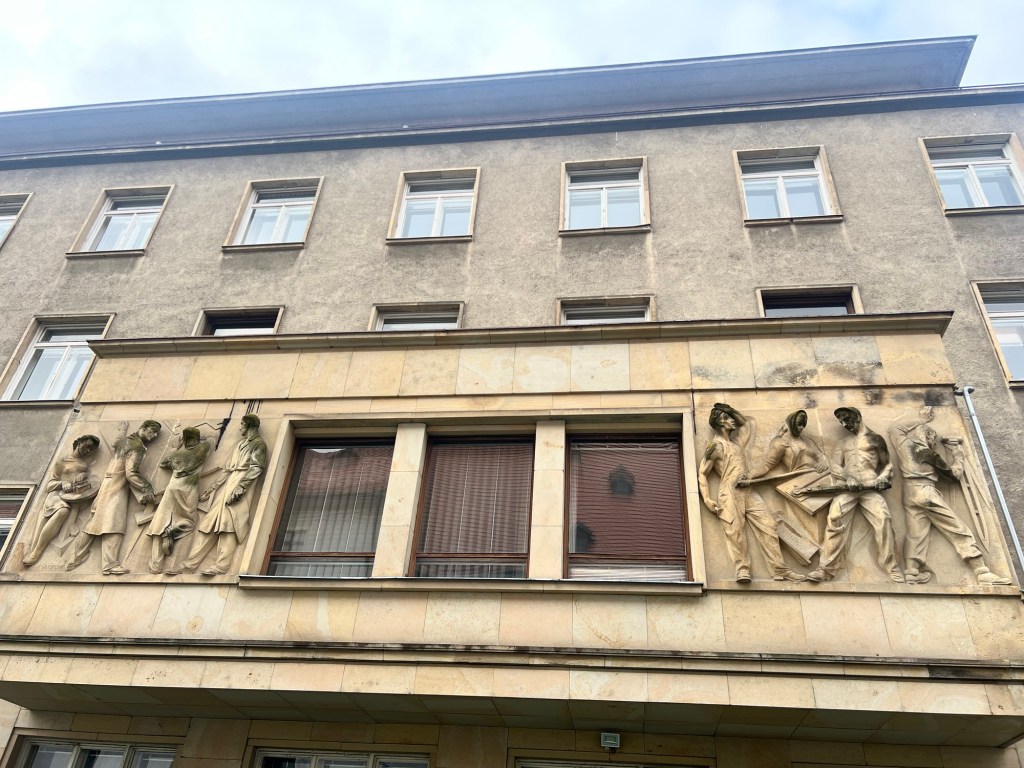
Socialist realism reliefs

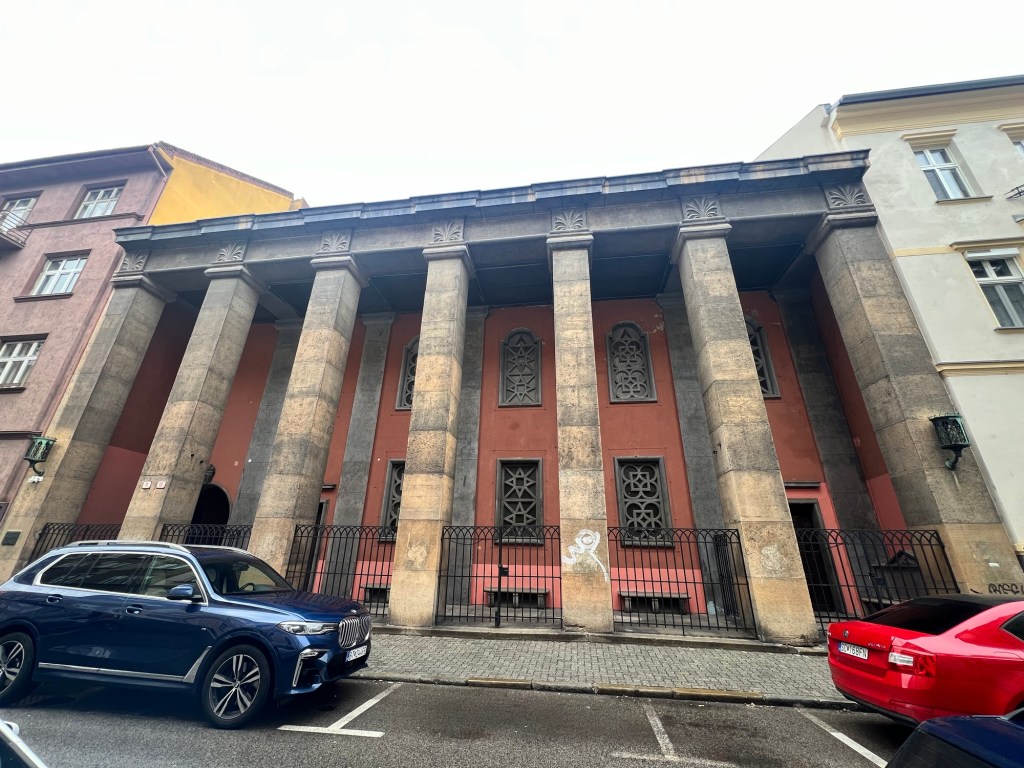
We learned about the city’s Jewish history. Of the 85,000 Jews in Slovakia, fewer than 10,000 survived WWII, and fewer than 500 stayed in Slovakia when it transitioned to Communist Czechoslovakia. The city has only 1 remaining synagogue to serve the remaining population.

Only remaining synagogue in the city

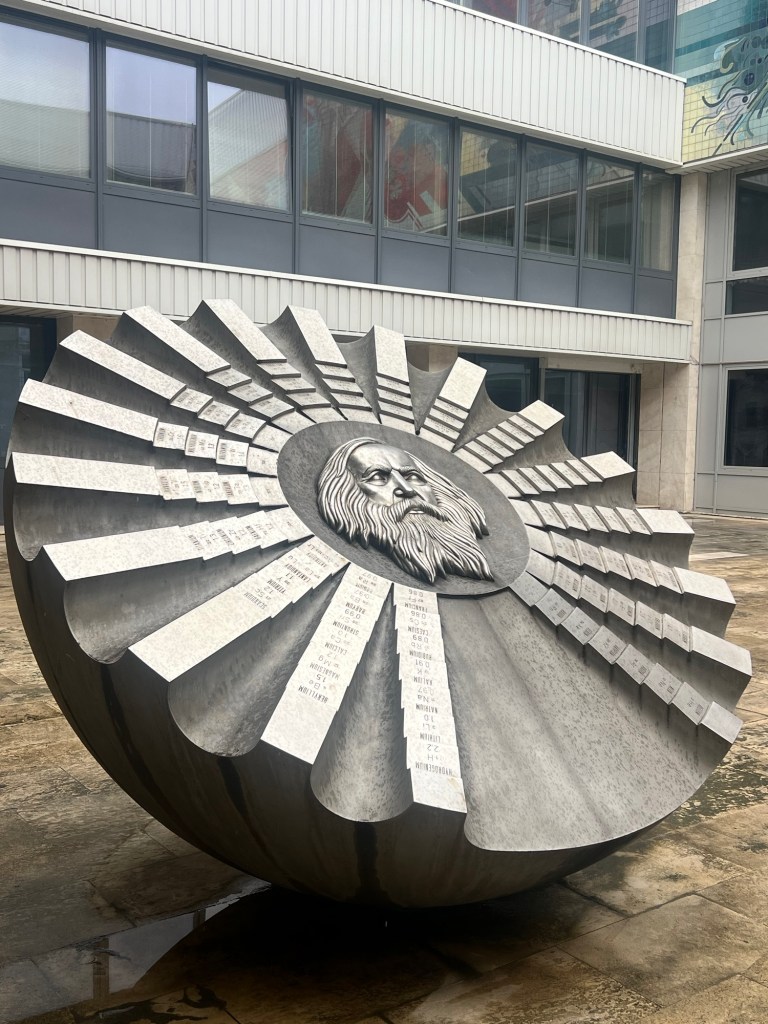
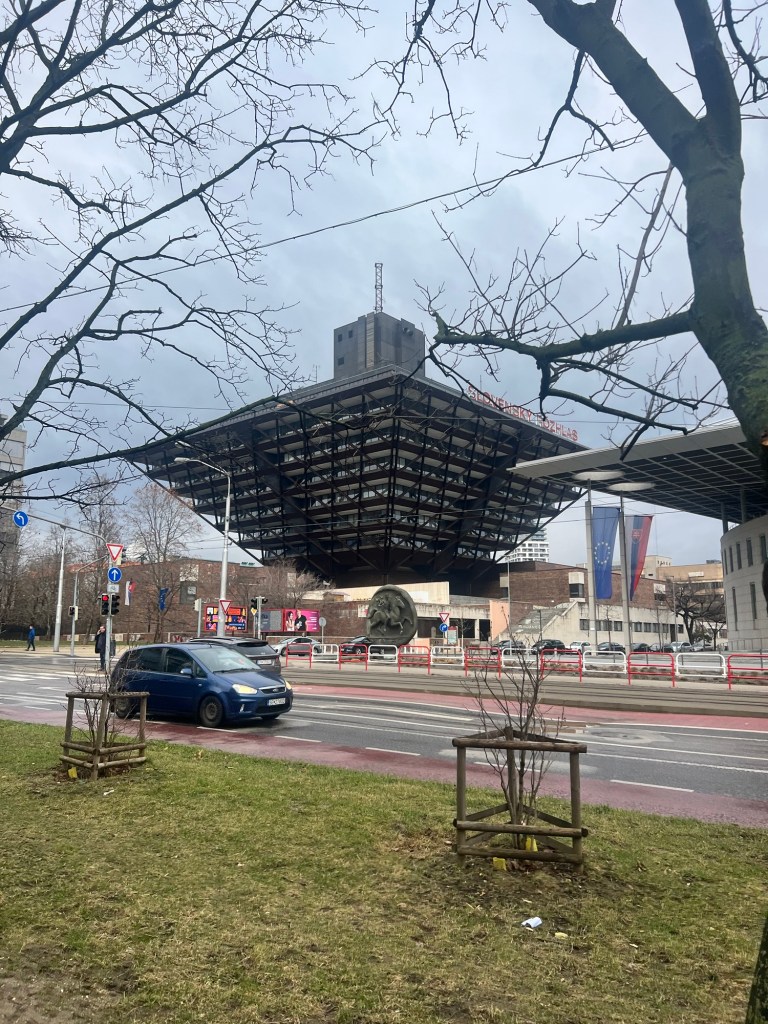
Throughout the past 70 years, Slovakian architecture also featured public art as part of a law requiring 2 pieces of art with every building development.

Periodic table outside the technical university
TV building, voted one of the ugliest buildings in the world (Boston City Hall is worse, if you ask me)

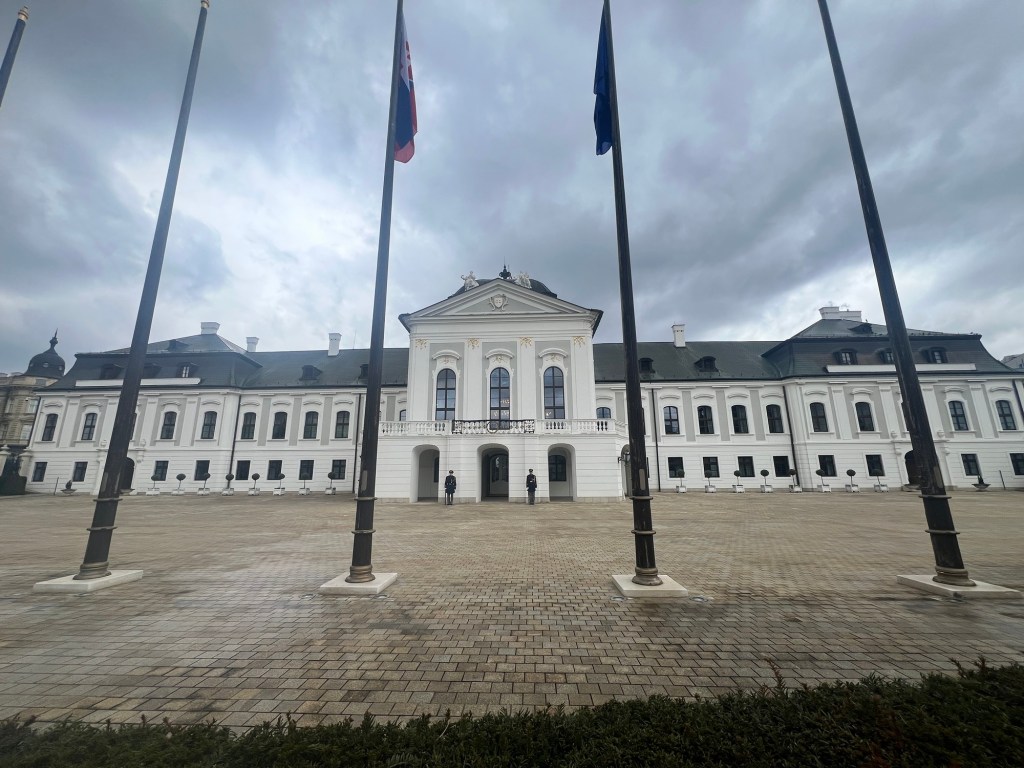
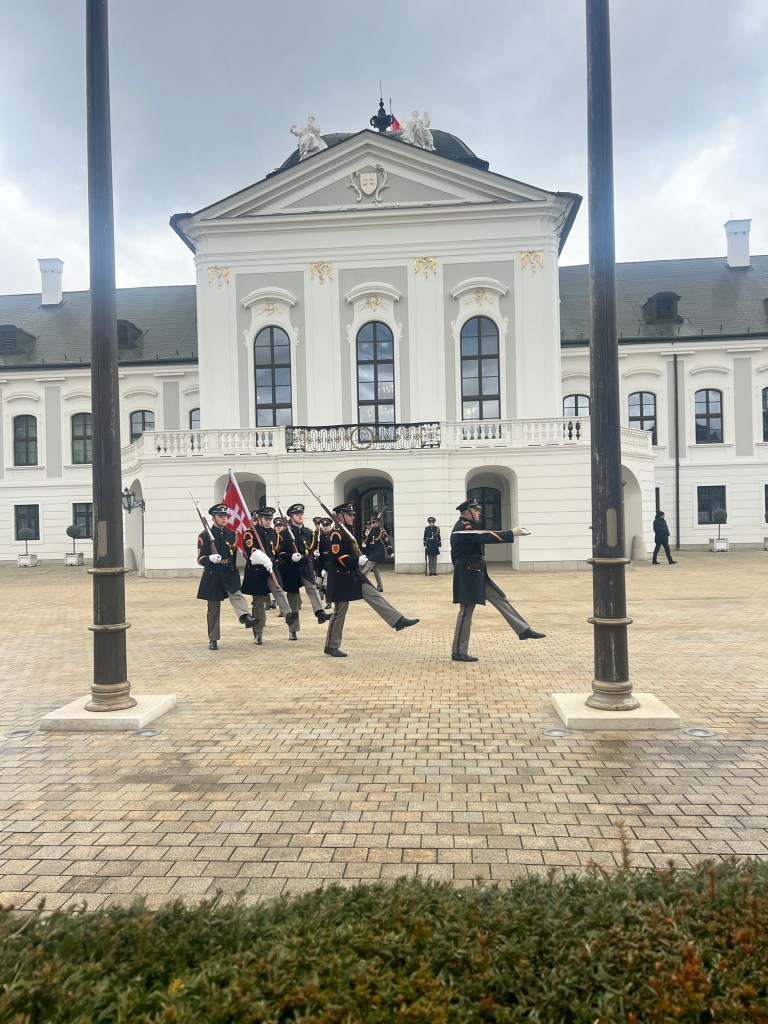
Slovakia recently elected a female president, something I’m not confident I’ll see in the US in my lifetime. She’s opted not to live in the Presidential Palace, although she still goes there to work. We watched the changing of the guard and all agreed that having to stand completely still for an hour would be miserable.

Presidential Palace
Changing of the guard

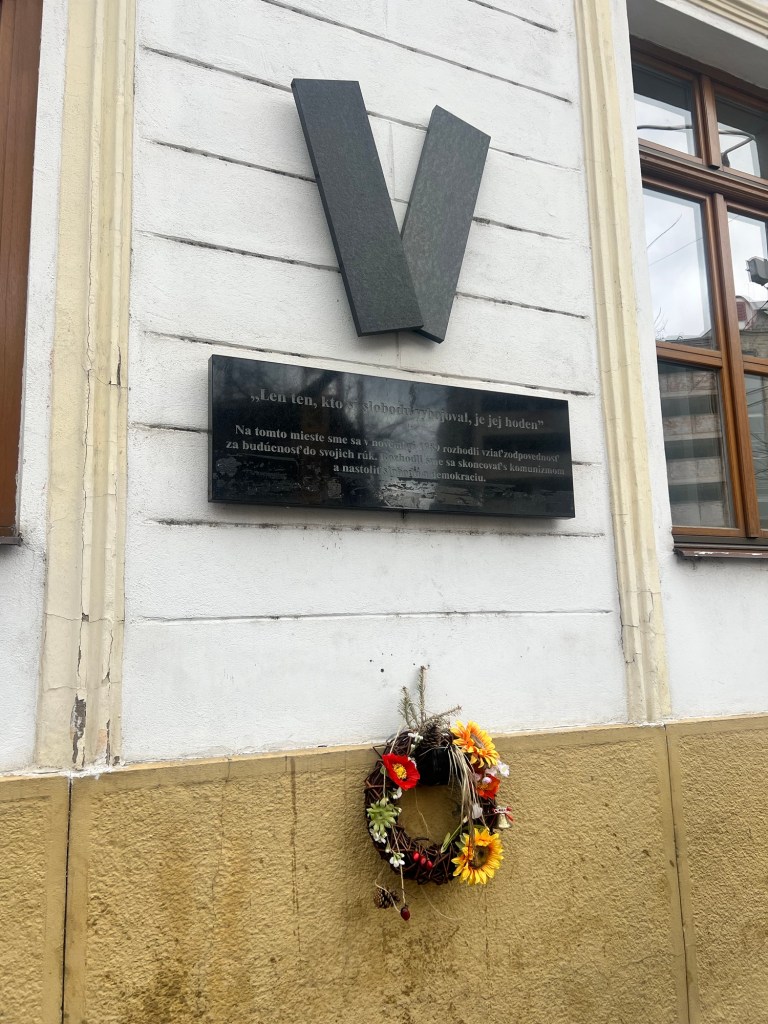
We wrapped up the tour at the memorial commemorating the Velvet Revolution, where our guide outlined the breakup of Czechoslovakia (a velvet divorce, as he called it).

Velvet Revolution commemorative placard

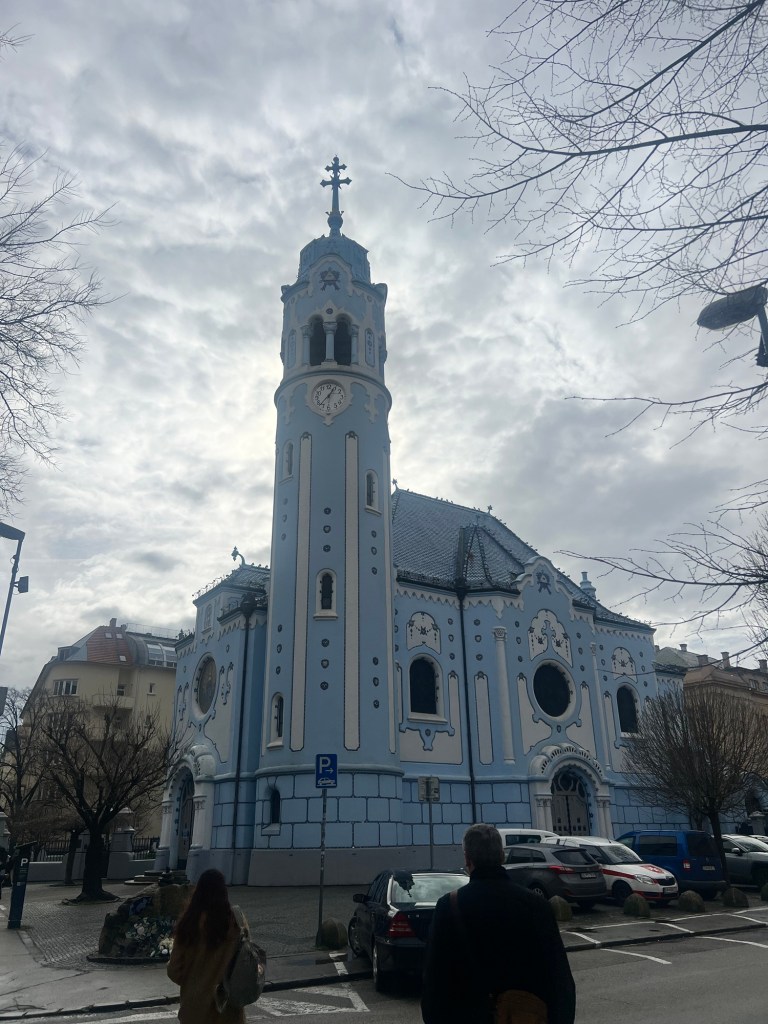
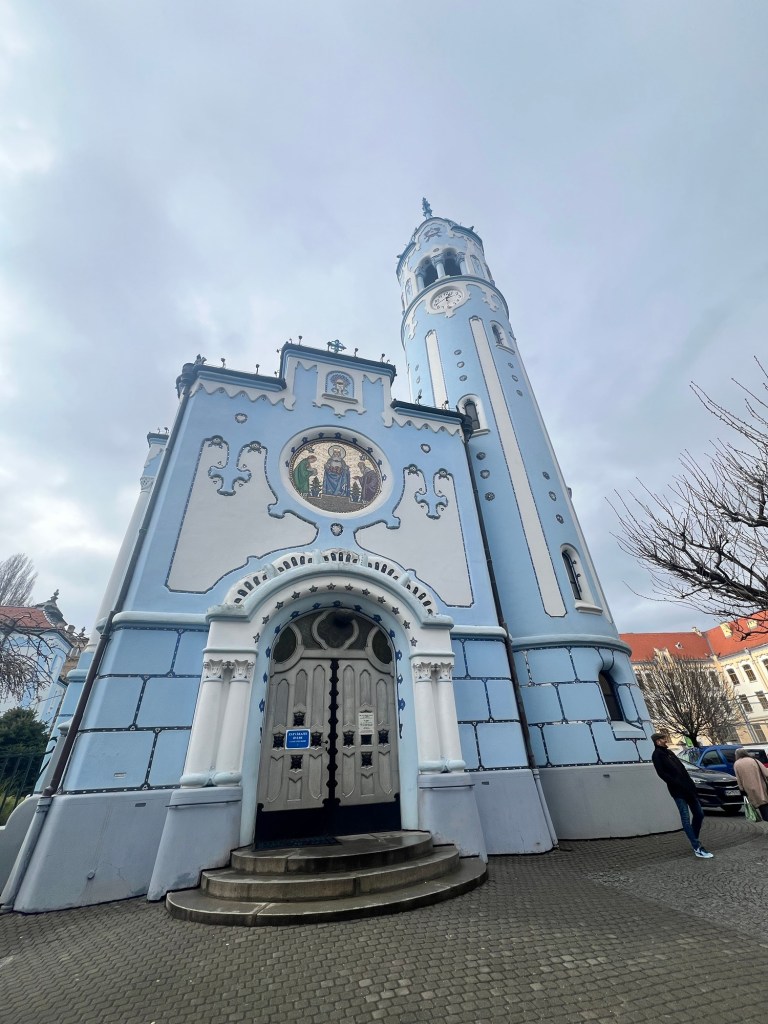
As we set out on our own, we set our sights on the Blue Church. It seems all of Bratislava has weird hours and all of those weird hours exclude Mondays, so we couldn’t go inside, but it was super cool on the outside. This looks nothing like any cathedral I’ve ever seen. It’s a sort of mix of big cathedral, soft Art Nouveau curves, and pastel coloring of nothing I’ve never seen in a cathedral before.

Blue Church
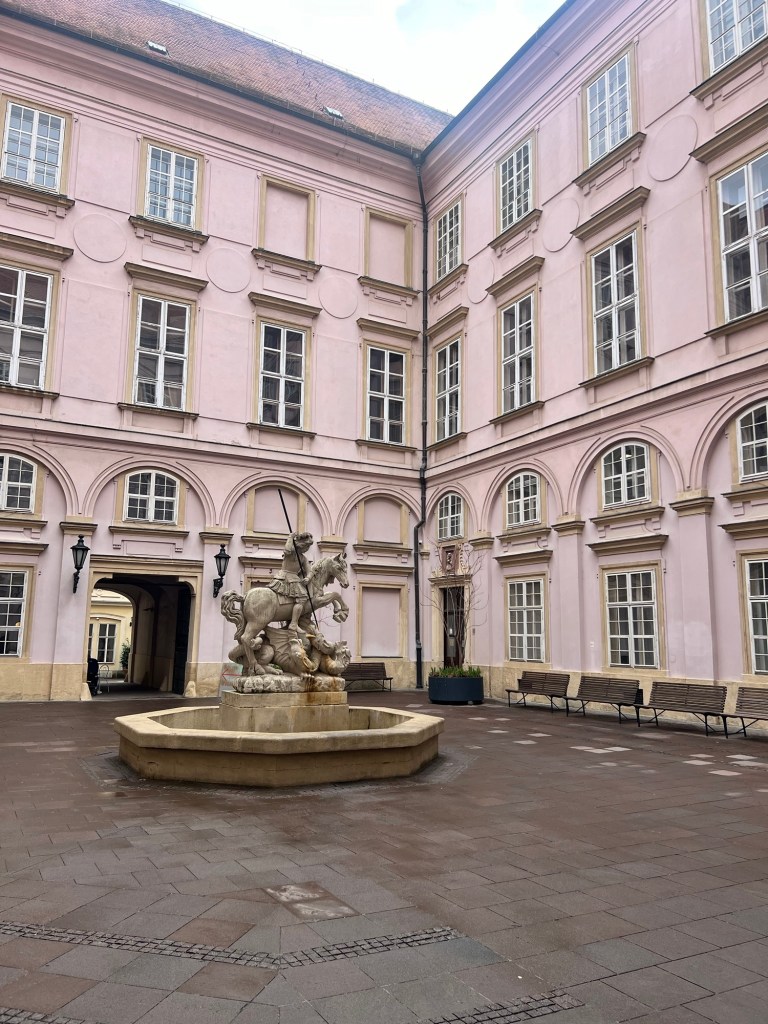
Cool pink building

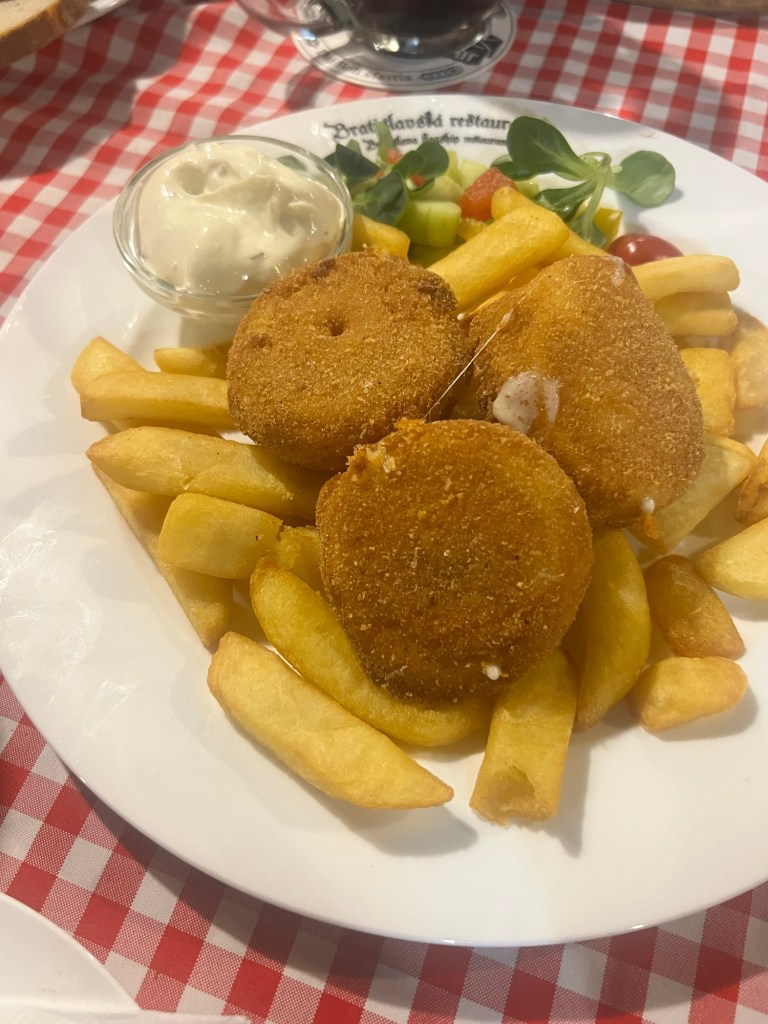
Lunch was at a place that was originally built to house a monastery and public hospital in the 16th century, but is now a brewery and restaurant. Food was traditional Slovakian, which apparently means absolutely no green veggies of any kind, but plenty of potatoes, cheese, and meat. Thankfully, they seem to be totally OK with vegetarians as long as cheese and potato are ok. That’s ok with me!

Fried sheep’s milk cheese
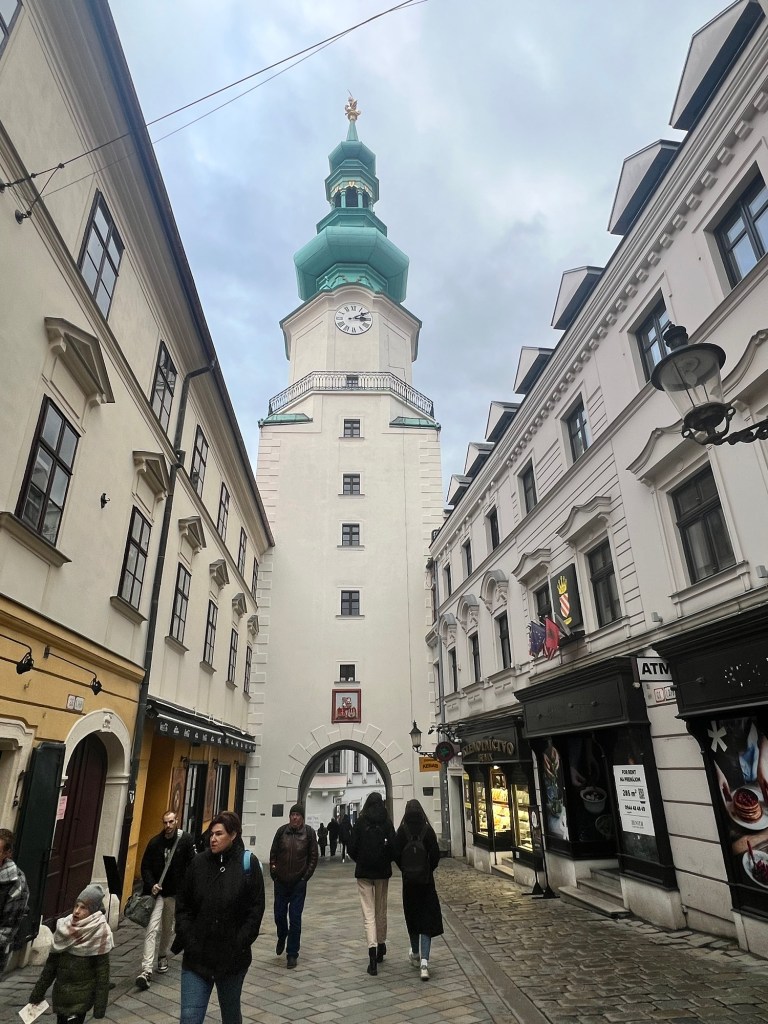
Michael’s Gate, built in 1300 and reconstructed in 1758

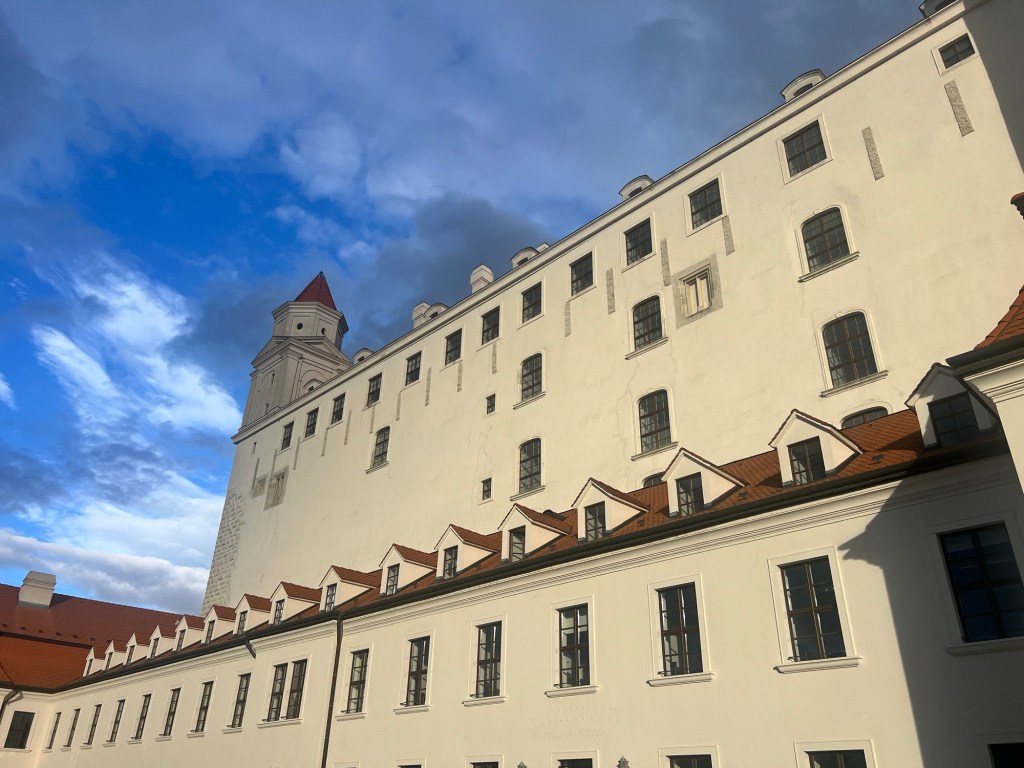
We meandered our way up to Bratislava Castle. This has a strong Bavarian castle feel, with the symmetrical walls and turrets on the corners. It’s on top of a hill (of course), so we had quite the workout getting up there!

Bratislava Castle
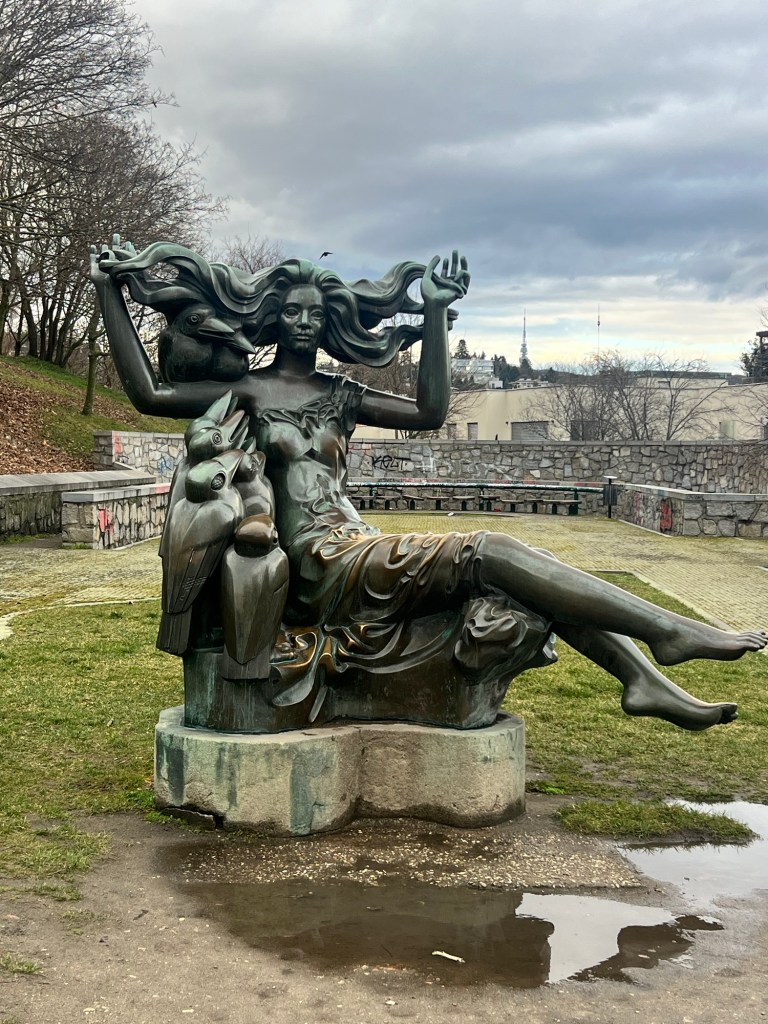
No idea what this statue is of, but we all agreed it was pretty cool!

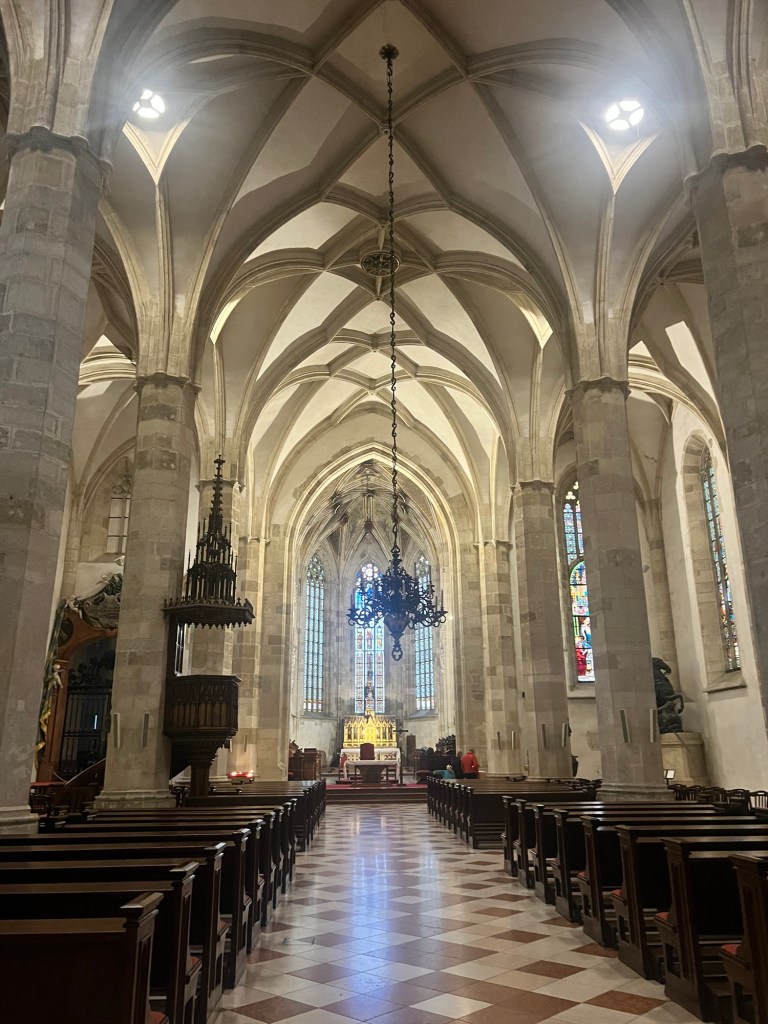
Since the castle wasn’t open, we explored the exterior and then left to see two more sights. First up was St. Martin’s Cathedral. This was a quaint cathedral by most standards, and I appreciated the modest scale as compared to a cathedral in Spain, France, or Italy.

St. Martin’s Cathedral

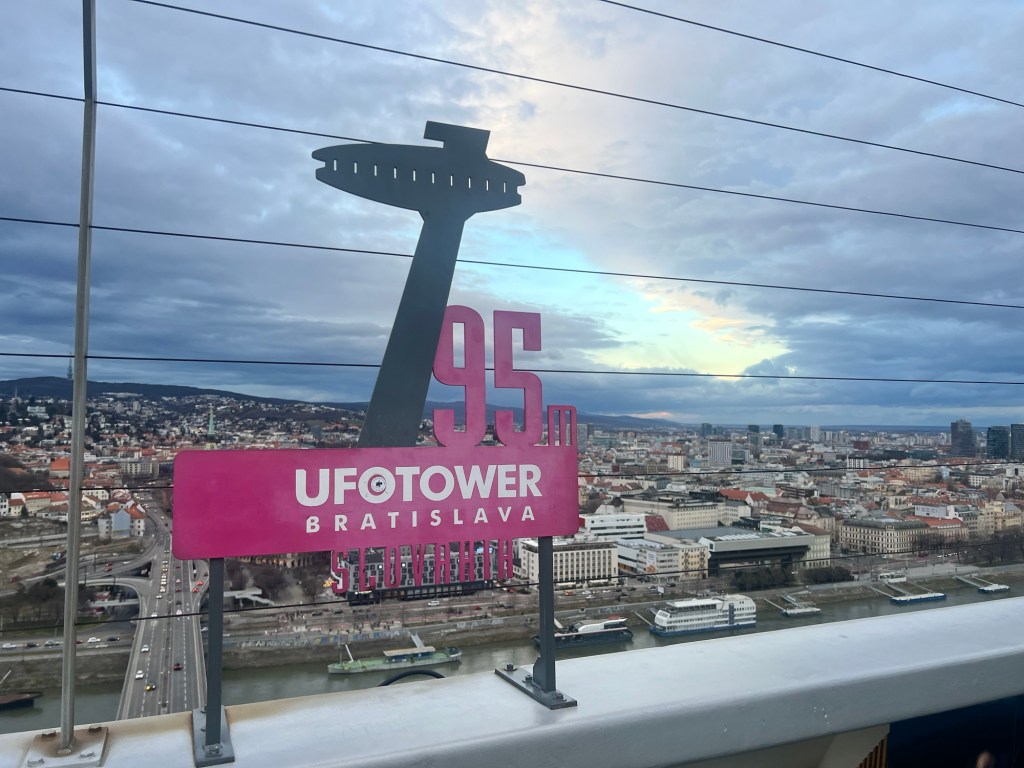
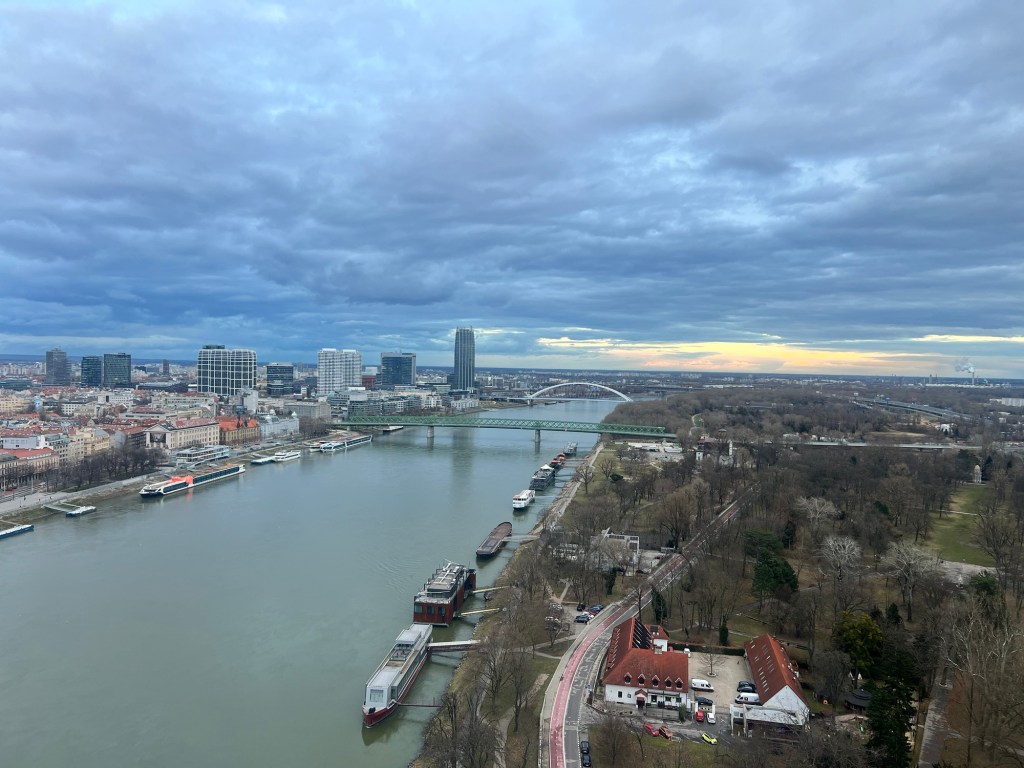
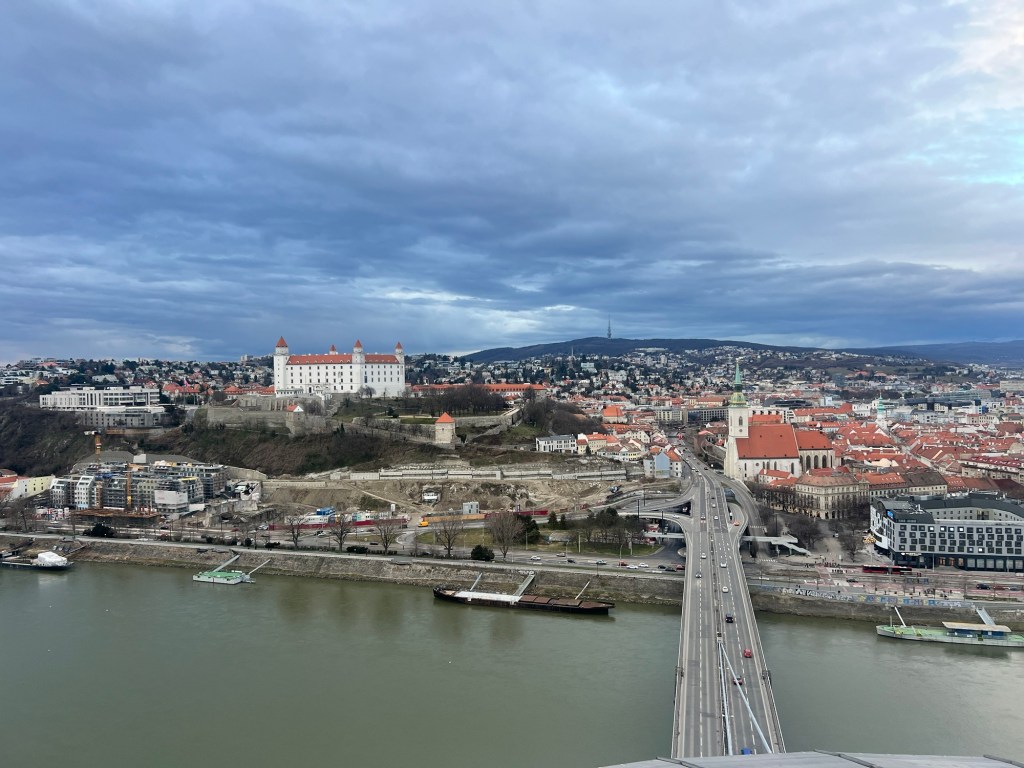
Last event for the day was the observation tower on the UFO bridge. On a really clear day, you can see Hungary and Austria from up here. It wasn’t quite that clear, but the views were still fabulous.

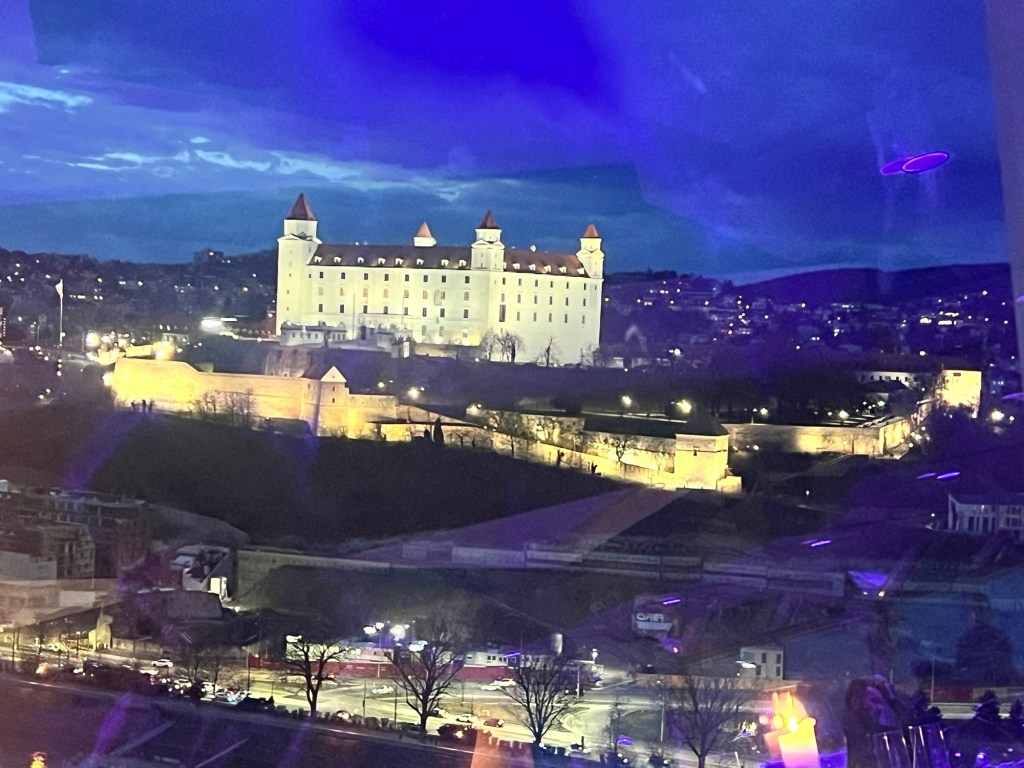
We leaned hard into the tourist angle and had a drink in the rooftop bar while the sun set over the city.

Bratislava Castle, seen from the UFO tower rooftop bar

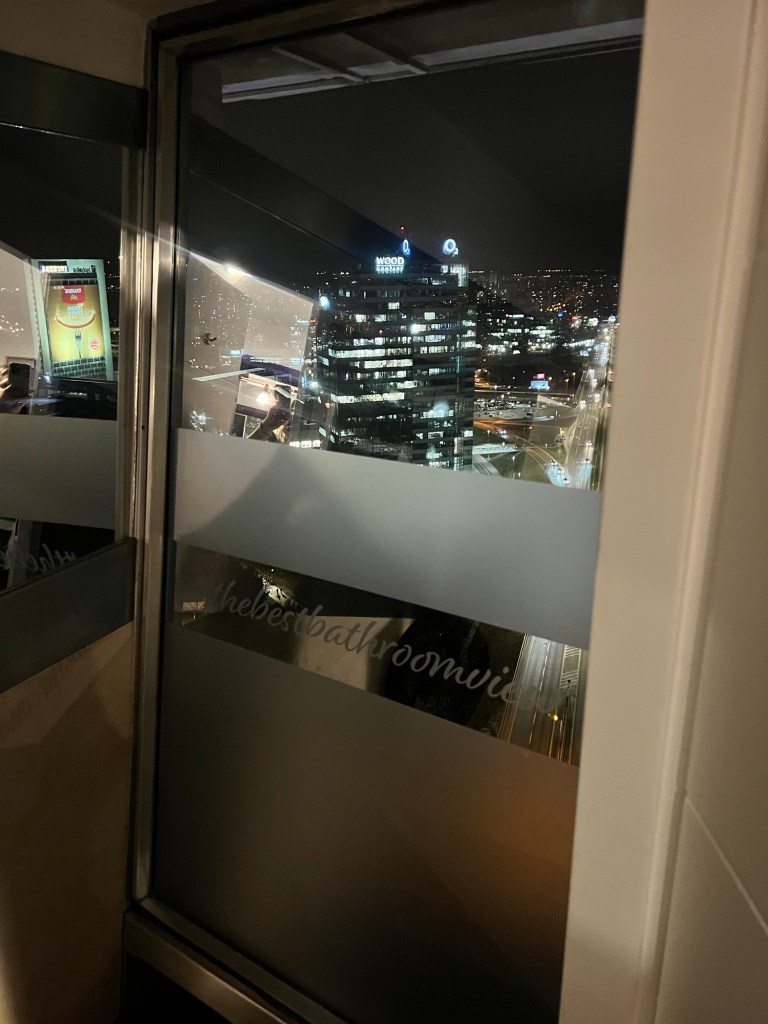
Anybody who knows me knows that I never leave a bar or restaurant without using the bathroom. These facilities were hilarious! They are all glass with some strategically placed frosting. While I’m confident the street is too far away for anybody to see anything, the glass certainly makes you think about how you pull your pants up. 🙂

#thebestbathroomview indeed!!

Dinner was at a little pub near the hotel. They had soccer on the projection TV, but then switched to hockey. I’ve never traveled someplace that appreciated hockey (other than Canada and the US), so it hadn’t crossed my mind that the Czech and Slovakian Republics would watch NHL hockey. In hindsight, of course they would like hockey – a huge percent of NHL players come from this region. Some hockey, Pilsner Urquell on tap, some excellent fries, and the best companions wrapped up a great day!

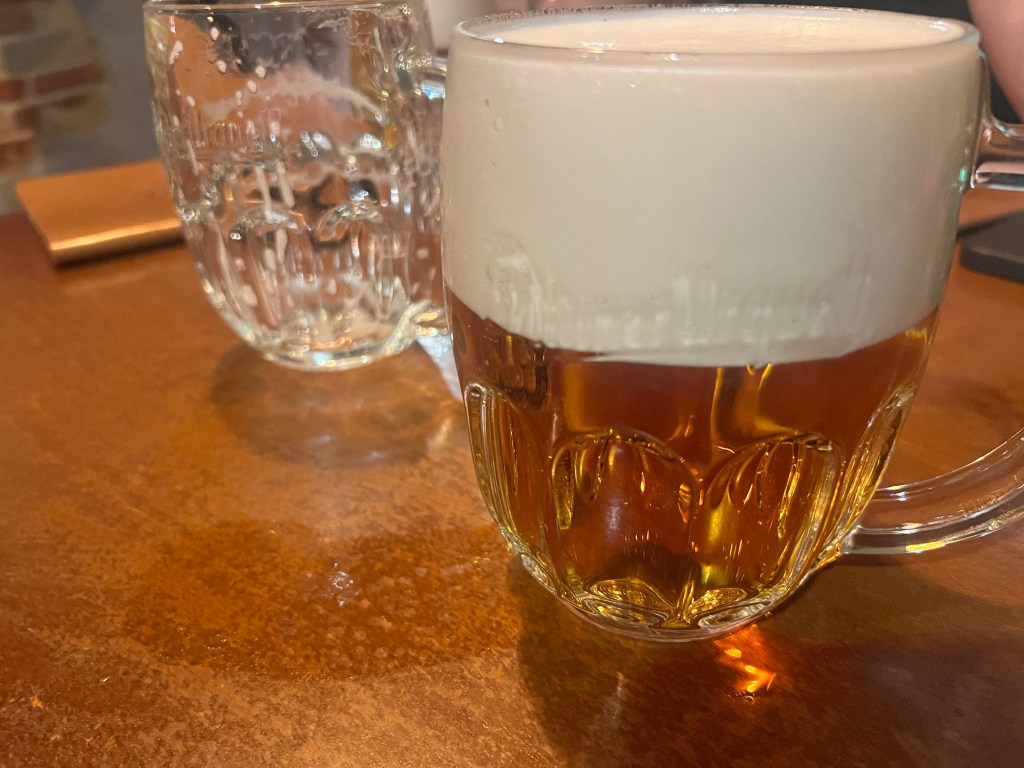
Pilsner Urquell on tap is one of this world’s great wonders

Tomorrow we are off to Budapest. I think one day here was OK, but a 2nd day wouldn’t be a bad thing (3 seems excessive – the city is small). I was expecting a grey, boxy, somewhat soul-less city, but I was so incredibly wrong! This was one of the most surprising cities I’ve ever been to. It surpassed my expectations in every possible manner. Budapest, you have BIG shoes to fill!

Perils of travel

We have had our fair share of thrilling experiences and been to our fair share of somewhat dangerous locations over the years. Great White Shark cage diving in South Africa, a face-to-face encounter with a wild hyena in Botswana, exploring Medellin and Nairobi…all things others might see in a guide book and skip. Yet of all the experiences that may result in my demise, I believe the red-eye flight is the most dangerous/miserable.

We left Boston at 6:00pm. We landed in Dublin at 11:45pm Boston time. That math just doesn’t add up if you try to include sleep in the equation. We checked in to our flight to Bratislava, then kiddo and I slept on the airport floor for 80 minutes. I am too old to sleep on the floor, but MUCH too old for 80 minutes to count as a night’s sleep. I tried sleeping on the flight to Bratislava, too, but the man next to me woke me a few times, first to help him open the bottle of vodka he brought on board, and again when we were landing because he was so incredibly drunk that he couldn’t understand how to buckle his seatbelt.

Anyway, we got a taxi, dragged our exhausted husks up to our penthouse room, and barely said goodnight before enjoying the best 3-hour nap in the history of humankind.

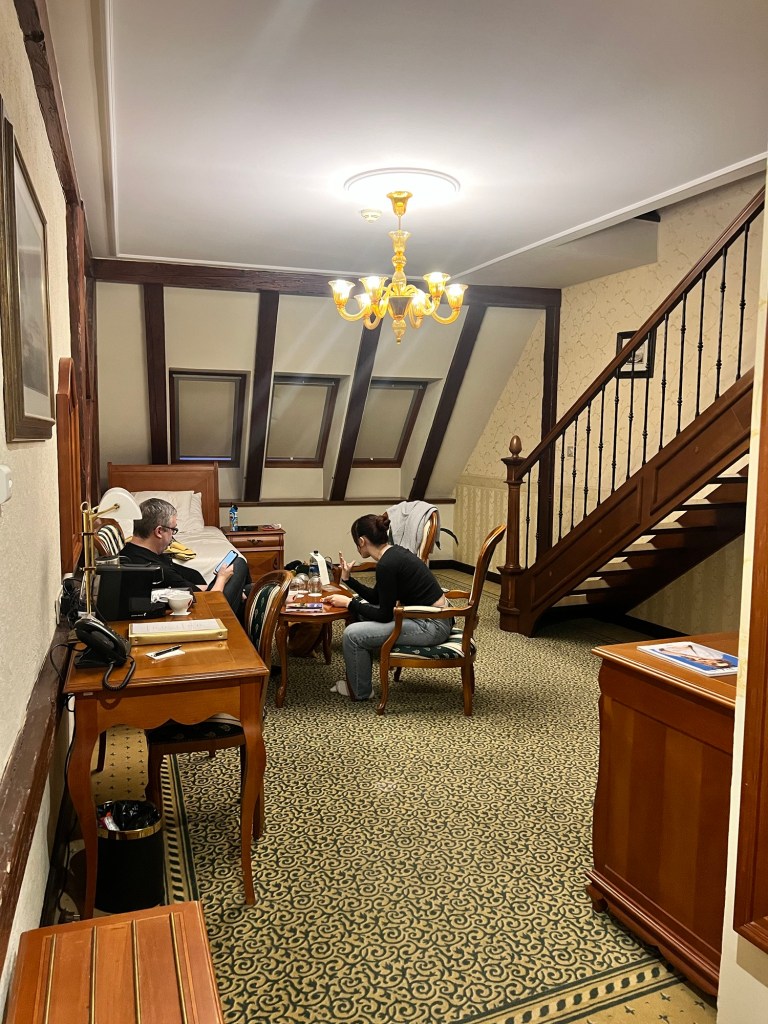
First floor of our hotel room, with a king bed upstairs for the adults

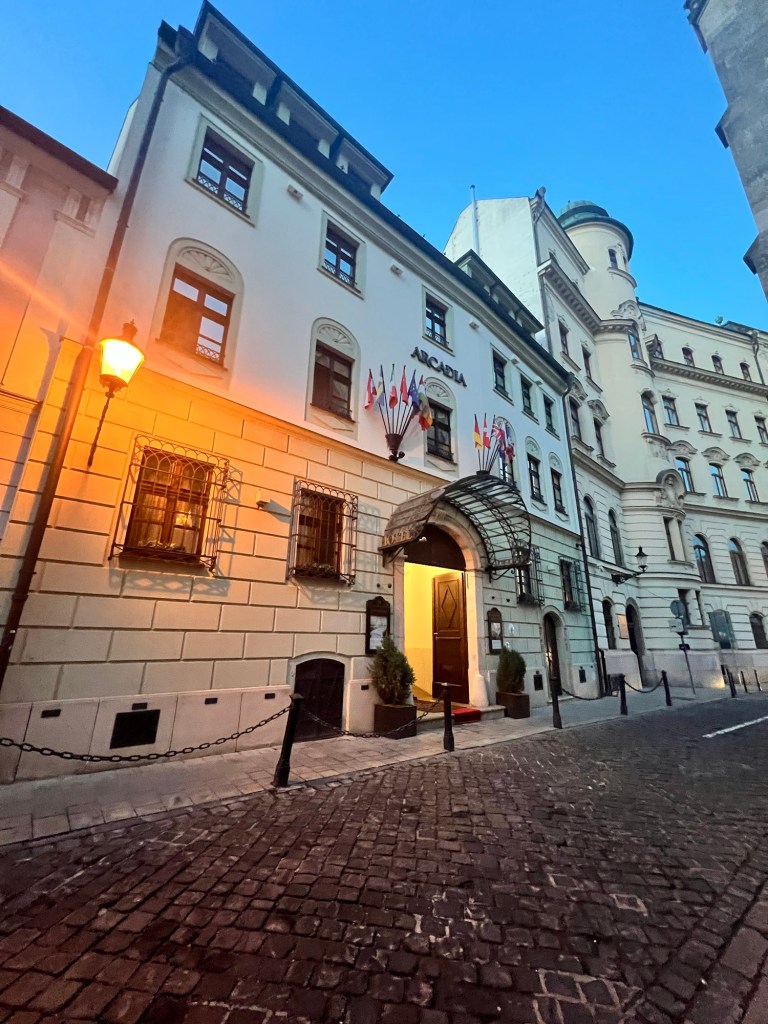
This hotel is stunning. Hotel Arcadia. It’s quite old, with ancient Roman artifacts regularly turning up on the property, and architectural and decorative elements from the Renaissance, Austro-Hungarian, and Habsburg eras. Like most places we go, finding a room for 3 was tricky so we ended up at one of the nicest hotels in the city (yet reasonably priced!). No complaints! It’s comfortable, spacious, and has a cool multi-century history.

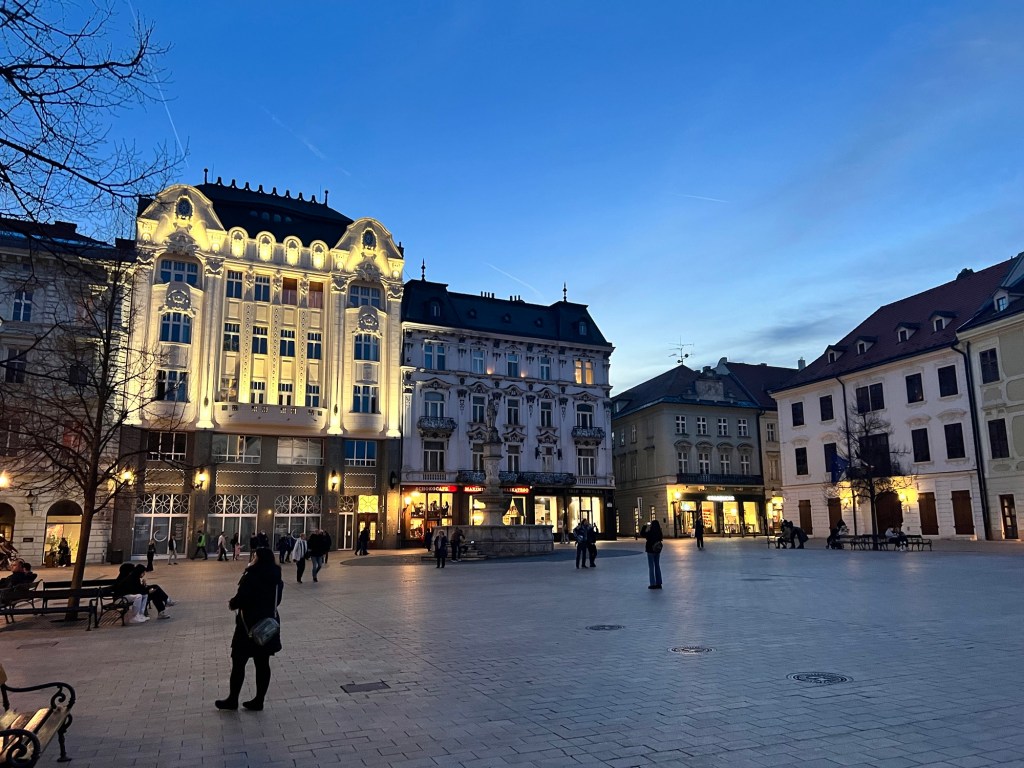
After our life-saving nap, we went out for coffee, a walk, and dinner. Bratislava calls itself the “biggest little city” and I can see why. It’s got a tiny footprint, but packs a lot into that space. And Old Town is so gorgeous. So gorgeous that I was recreating the scene from Despicable Me where Agnes grabs the stuffed unicorn and squeals “It’s so fluffy” as she struggles to contain her joy, except I swapped fluffy for adorable.

Our hotel
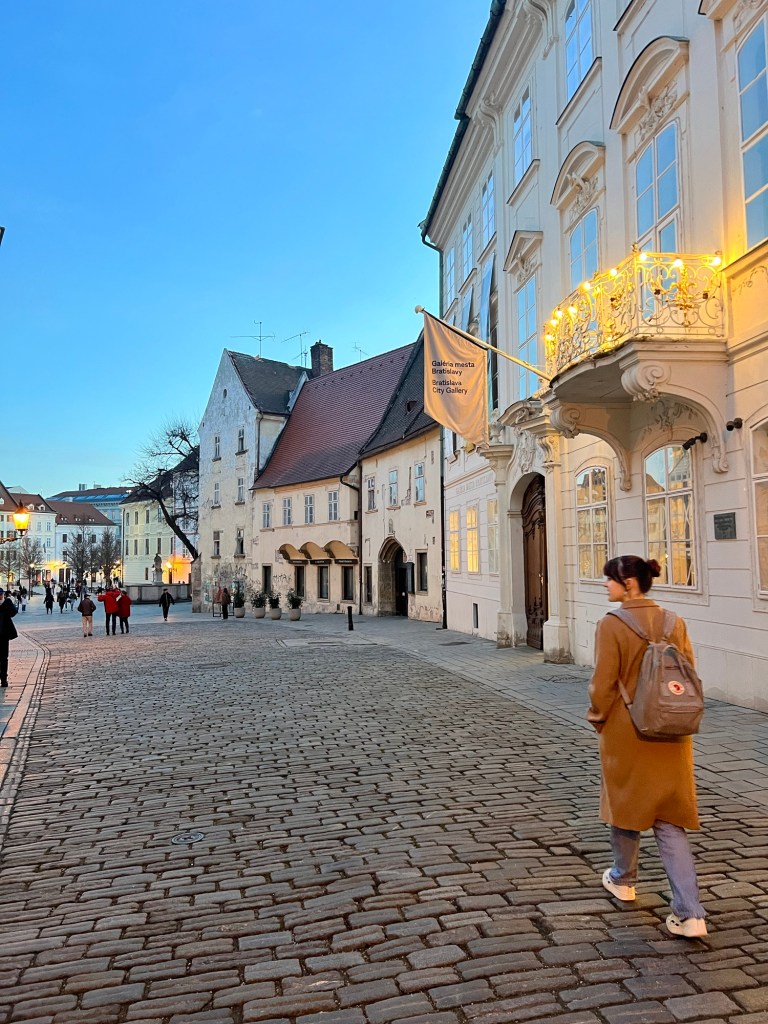
Cobblestone streets of Old Town
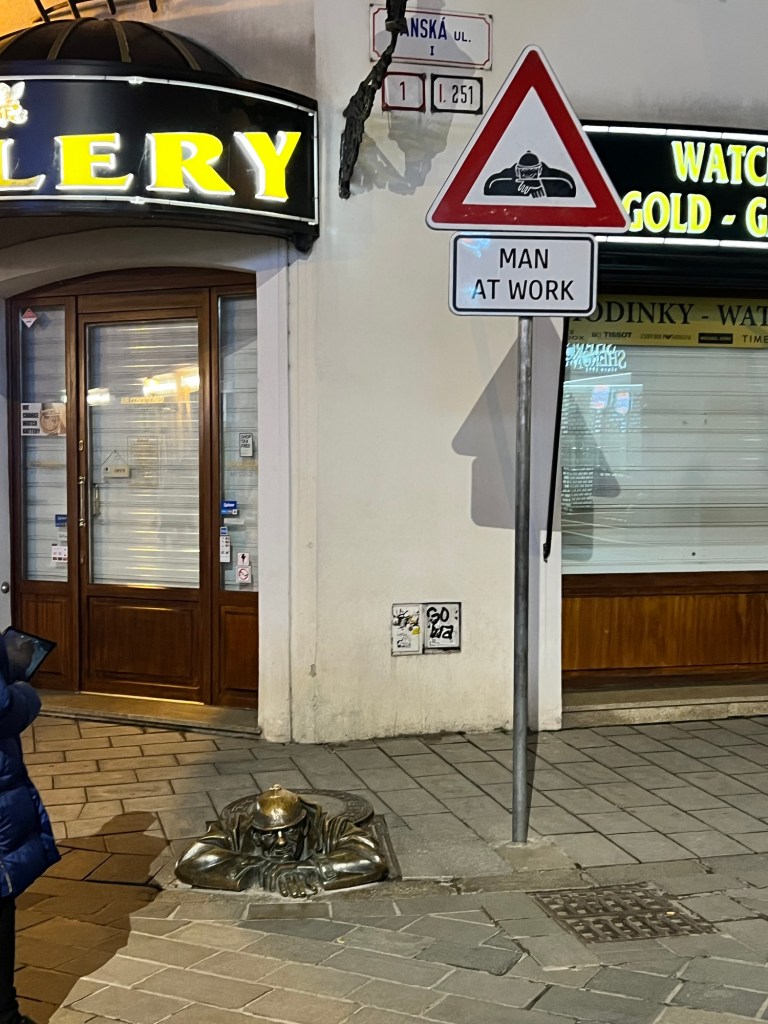
Man at Work sculpture

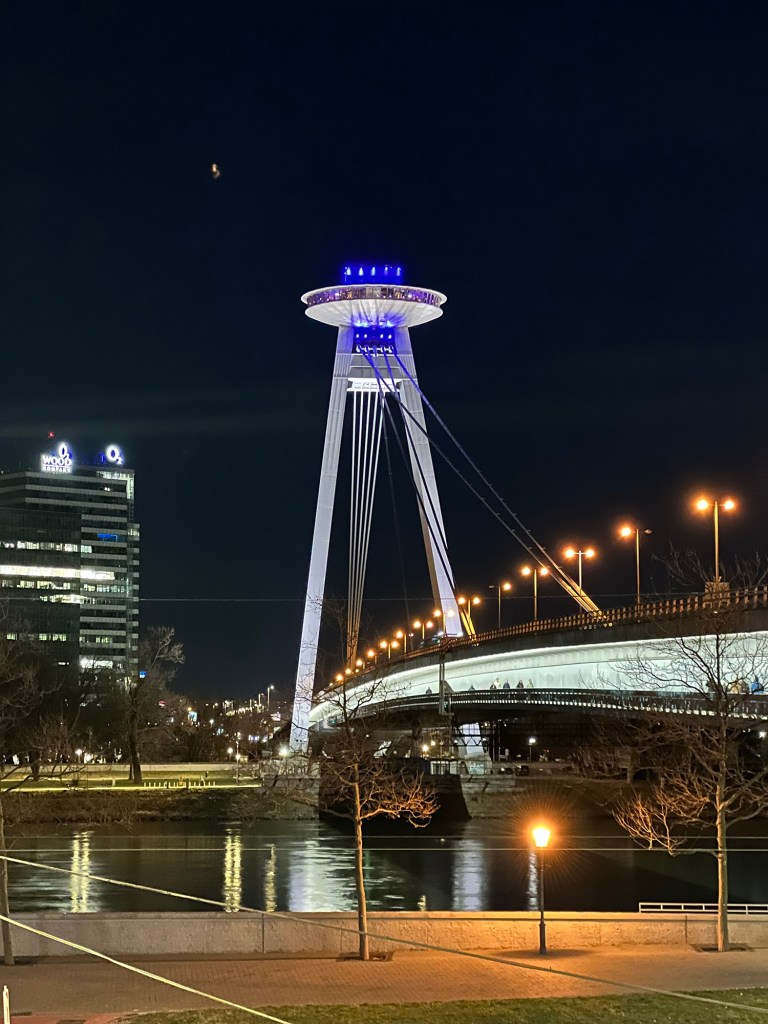
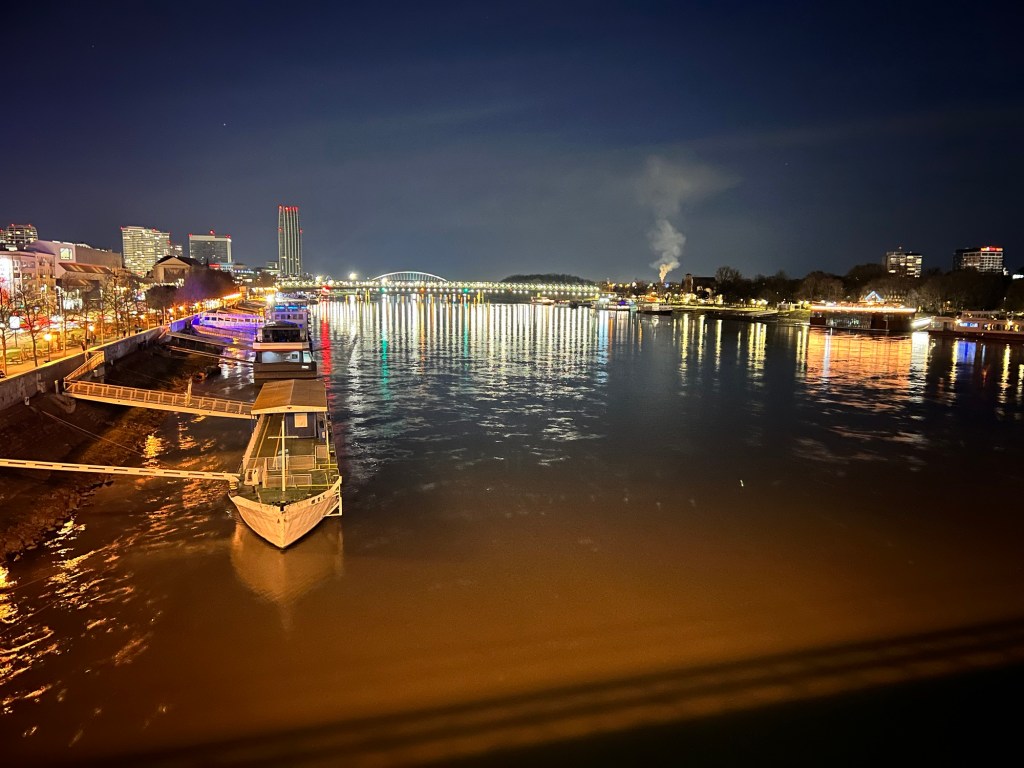
We took a walk through Old Town (so cute!!!) and then over the UFO bridge. It’s sad that 2/3 of Old Town and the Jewish quarter were destroyed in the 60s and 70s to make way for this bridge, but at least there are nice views from it.

Danube River
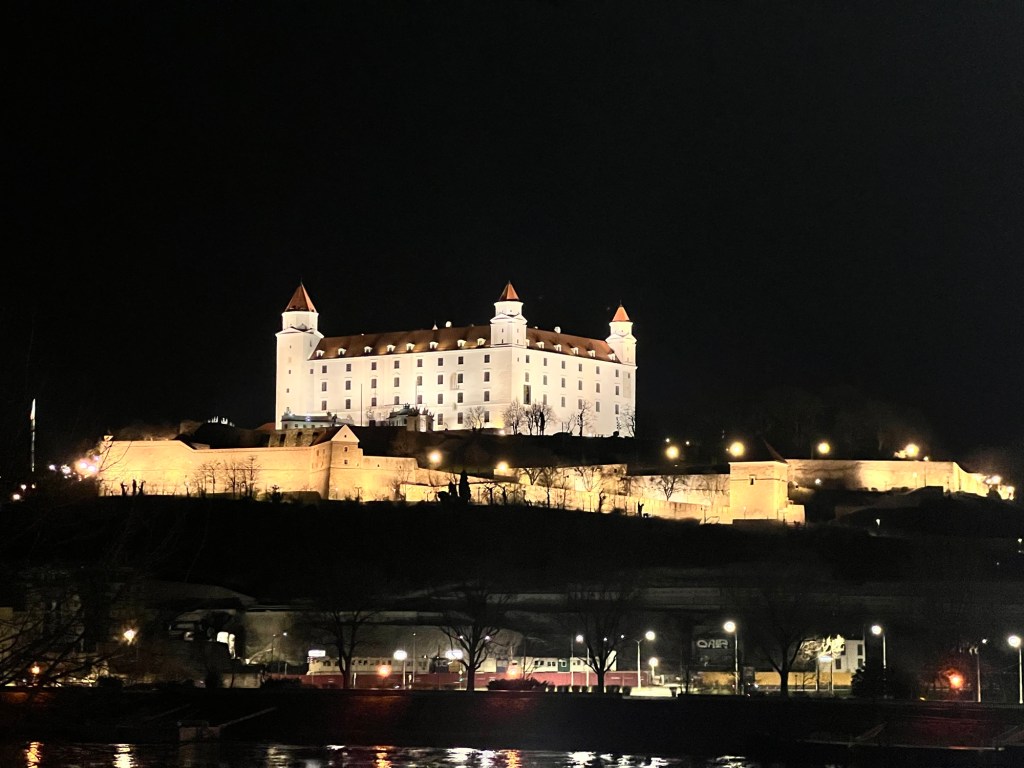
Bratislava Castle

We stopped for dinner at a place near the hotel and sampled Slovakian wine (not bad, but I would suggest the rose over the red). Although my guide book says nobody speaks English, we’ve had no trouble finding English-speakers (of course, we are in Old Town which is the main tourist center). Our server at dinner was asking where we are from and why we chose Bratislava, which makes me think American tourists are not that common (wouldn’t surprise me, since most American tourists prefer more mainstream destinations). He was friendly and spoke excellent English, so we are giving a five-star review for our first evening here.

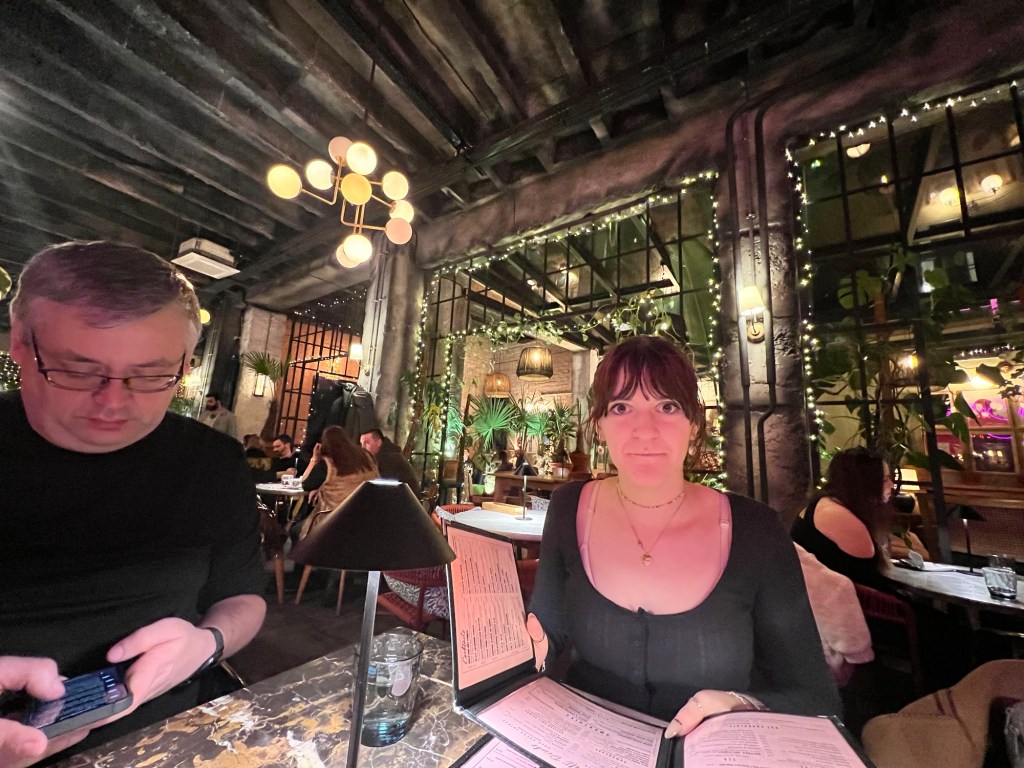
Two American yahoos at dinner in Bratislava

After what I expect will be an amazing night’s sleep, we will hit all the sights tomorrow!